I hiked the Kungsleden, Sweden's Kings Trail, in the fall of 2005. This is the travelogue of my adventures on the arctic tundra.
 Prologue
I don't sleep much anymore. But this morning is unique and, as the train's alto whistle cuts through the bass rhythm of wheels and tracks, for once I don’t mind my insomnia. It is four o'clock in the morning and I lay listening, waiting. I pull back the rough fabric of the window curtain. At this time of year, and at this latitude, the early hours of the morning are eerily luminescent. Through skidding droplets of mist, miles of birch trees and scrub pines fly past.
This six-seat cabin is a model of stuffy efficiency. For night travelers, cots fold down from the walls, transforming the compartment into a hostel. On a crowded night you could suffocate in the smell of your five companions. Tonight we are, mercifully, alone. I took the bottom left berth and Charles, my traveling companion, has the opposite. He sleeps like an Egyptian king, wrists crossed over his chest, torso and legs wrapped tightly in his sleeping bag. The other four bunks are vacant. A polite, soap-scented mortician started the journey in our cabin. He is also headed for the Kings Trail. Around midnight he quietly bundled his bag and slid out the door to find his peace elsewhere.
We boarded in Stockholm, city of canals and beautiful blonde bicyclists, 624 miles south of the arctic circle -- our destination. The trip to the Kungsleden lasts 18 hours, and we pull in around noon at a desolate brick building that serves as the last rocky outpost on the line. We follow a straggling queue to the nearby Abisko Turiststation, a sprawling red brick building with all the charm of a Soviet grammar school. There we make our final telephone calls, fill water bottles and weigh our packs on a hanging scale. With water, my pack weighs just about 40 lbs, Charles' pack weighs under 20.
“There's no way you have enough warm clothes in that pack.” I say as he pulls it off the scale's hook.
“I've got everything I need” he says, smiling triumphantly. He is an expert ultra-light trekker. Every year for the past six years he has refined his pack. Every ounce has been considered and justified. He's been emailing me tips every week. This is his moment of glory and I am impressed, though just a little apprehensive. At least one of us didn’t pack very well.
At the log cabin arch that marks the beginning of the Kungsleden, we stand together and I hold the camera at arm's length, snapping a shot of our two faces. The image, roundly distorted by the close camera lens, shows the two of us smiling with eager anticipation.
Day 1 We hit the Kings Trail at a double-time pace, hardly knowing what to expect from the coming days. The trees beside the path are little more than shrubbery, knotted and arthritic, contorted from cruel, bitter winters. Few reach a height of more than fifteen feet. The effect is primeval and speaks of harsh weather and unforgiving cold. It is a fantasy movie landscape where reindeer are said to roam freely and, as recently as the beginning of the twentieth century, the native Sami people still lived undisturbed as nomadic herders. Some lonely ascetics remain but most have now left for the city.
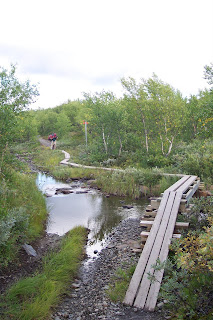
This afternoon we will walk eight miles. On relatively flat ground this is not a long hike, and we should have clear daylight until 9PM. We break in our boots on well-packed dirt. Through frequent gaps in the trees, miles of low green and brown hills roll off in all directions. Small patches of snow dot the higher plains. Under our feet, the tundra has melted in many spots but boards have been handily placed over the marshiest patches. With no other signs of civilization, the views are eerily spectacular.
To our right is a river that we’ll skirt all the way to Abiskojaure. From time to time we catch a glimpse of its clear, rushing waters. The air is fresh and damp and the weather is cloudy but the rain holds off. The temperature hovers in the mid fifties with a breeze of fifteen knots or so.
Any troubles this afternoon are of my own making. I am often hopeless with adjustments, especially on the first day of a hike. First, my jacket comes off, next I want my hat, now I need to check a spot where my boot is rubbing too tightly. I’m wearing my favorite trail footwear, Lowa® trekking boots, but I have made the rookie mistake of tightening them too snugly. An hour into the hike I rest on a rock and run my hand over a rising bruise on my shin.
“Need any moleskin?” Charles asks, referring to a soft adhesive pad that hikers often carry for such emergencies.
“Nope, you go on ahead. It's nothing, really.” That's code for “Let's hike solo for a bit.“ I hate to slow him down and we are both loners at heart. Since he doesn’t share my compulsion for fine-tuning gear on the trail, there is really no point in him waiting for me.
Five minutes later I’m all sorted out and back on my feet. I walk another quarter of a mile before it really hits me; I’m alone in an arctic wilderness. An bird cries overhead, my boots clop softly on the dirt, my pack creaks a bit, otherwise all is miraculously silent: no airplanes overhead, no sirens, no traffic, the train is too far off to be heard.

The Kungsleden takes me south, through the Abiskojakka Canyon. To my left a hulking plateau ramps up and then drops off sharply. To my right, the Abiskojakka river plays hide and seek with the Kings Trail. Aluminum bridges cross tributaries that join from the East. When my water runs low, I scramble down banks of ice-crushed gravel to refresh my bottle with sweet, numbingly cold water. These brooks and rivers all feed the Abiskojaure lake, on the other side of which lies today’s destination.
As the sky begins to clear, I pass a traditional Sami shelter. Like a scruffy boulder, this sod-covered igloo sits on a treeless mound. Unpainted boards block the window and door. A thin, rusty duct pipe extends through the roof from what must be a small stove inside. A clumsy haircut of grass grows from the top. Off to the right, a chair, of dry crooked tree trunks, sits patiently vacant.
I gawk for a moment at this reminder of the subsistent, nomadic life that is vanishing as the Sami people relocate to the suburbs of Stockholm. Then I humbly cinch up my Goretex® pack and continue down the Kings Trail.
After two more hours of blue skies and rolling greenery, I catch up with Charles. He is sitting on a lichen-covered stone with his rucksack beside him.
“How’s your shin?” he asks.
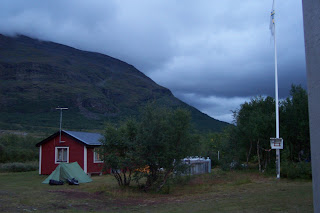
“A little sore” I say. “We’ll see tomorrow morning.”
From the fork in the trail it is clear that our tent-site, the Fjällstuga Abiskojaure, is just across the Kamajakka River. We cross a suspension bridge, our largest yet, and arrive with plenty of daylight to set up our two solo tents. Even with all of my fiddling, the entire day’s hike has still taken less than six hours.
The Abiskojaure hut consists of a supply store, a bunk house, a flag pole and an arsenal of large aluminum propane canisters. Approaching the store we meet a jovial, middle-aged woman who shares the task of hut warden with her husband. We kick off our boots before entering the carefully swept little room. The shelves display a sparse collection of trail goods: maps, bug spray, canned meatballs and freeze-dried blueberry soup. I buy a soft drink, a post card and a small round patch – like a Boy Scout badge. The patch is trimmed in blue and yellow with what appears to be a white grouse-like bird in the center. The camping fee is about $10. The meatballs are calling to me but I leave them unmolested. I am determined to eat my 20 pounds of food.
We pitch our tents behind the store and spread our meals on a picnic table. My dinner is a fishy tuna-noodle casserole cooked over a homemade “cat” stove. The stove is built of cat food tins, punctured and fitted around a fiberglass wick. Charles found the design on an ultra-light camping web site, along with plans for his own “penny” stove. Mine takes two bottle caps of denatured alcohol to boil a pot of water, whereas his takes only one. But his stove is trickier to build and, as I did not care to explain a fully-built penny stove to a vigilant airport security officer, I opted to carry the pieces for the simpler model and build it on the train.
After dinner, in the dimming light of the sunset, I walk a quarter mile through the woods to the sandy shore of Abiskojaure Lake. I throw my clothes over a bush and wade into the cold water. I walk and walk until it feels like I’ll soon be standing buck-naked in the center of the lake -- but the sandy bottom doesn’t drop off. Self-consciousness finally overtakes me, as does the stinging, frigid water numbing my legs, so I plunge in, grab a handful of sand and scrub like a penitent. Sixty seconds later I am sprinting back toward the shore to the warmth of my dry clothes.
As I return to the campsite and crawl into my cramped little tent, Charles disappears into the woods on his way to the beach. He carries two one-liter bottles of water he has been heating. In his pocket is a perforated bottle cap. Through this homemade contraption he will squeeze out a warm, makeshift shower. For an ultra-light hiker, Charles travels in style.
Day 2 The next morning we break camp early. It was cold last night, perhaps close to freezing, but the weather gets warmer as the sun comes out. So far we have seen no mosquitoes. This goes against everything I’ve read about this hike, a pleasant surprise.
The biggest danger in this region is the weather. Arctic Sweden is notoriously cold, wet and capable of producing deadly storms on very short notice. Both Charles and I are playing our edge, traveling with minimal gear and sleeping in tents. In a pinch, we can sleep in a cabin but that doesn’t help between huts. Last night, around 2 AM, I had to layer on most of my spare clothes just to stay warm. This was, quite literally, a rude awakening. However, if I am ever too cold and without other options, I still have one last resort: my reflective metallic blanket. This thin plastic sheet could be the only thing between life and hypothermia. If it comes to holing up, I’m fairly sure I can ride out a storm.
Happily, the outlook for today looks fine. Despite some threatening clouds last night, the weather remained mostly dry with just a little rain between ten and midnight. By the time I roll my tent tightly and slide it into the nylon sheath, there is just a hint of dampness on the fabric. I breakfast on oatmeal with raisins and reconstituted milk. Charles warms up some leftovers. We both drink tea but Charles takes his twice as strong.

We retrace our steps across the Kamajakka River bridge. On the opposite side, we rejoin the Kungsleden and continue south. Two and a half miles further we cross a wooden bridge only three planks wide. It bounces like a bungee over the rushing Kieronjakka River. I give Charles my camera and he takes a video clip of me walking across. From here we begin our ascent up the plateau to the west of the Alesjaure Lake.
From the wind-swept plateau we can see for miles. Boulders litter patchy fields of stone, moss, grass and gravel. The scenery is dominated by the mountains, the most dramatic of which rise up to our left beyond the Alesjaure Lake. Many of the peaks have snow fields, and some are crowned with funnel-like craters that pour glacial snow down rocky chutes into the valley. Few of the mountains are very tall but even 1000 feet can make an extreme difference in the arctic.
With this grand view, we can each hike at our own pace with line-of-sight contact for miles. Today I hang back intentionally and let Charles hike on ahead. I have something that I hope to leave behind if the ground is not too stony.
Here the Kungsleden is a strip of gravel that runs through a barren landscape where the topsoil struggles to keep the stony ground covered. Down by the lake there are teepees and small red and black buildings. These are seasonal villages where the Sami stay when herding their reindeer. But that was earlier in the summer. Today the villages appear deserted.
Our goal today is Alesjaurestugorna, the hut at the end of the Alesjaure Lake. It comes into view many miles before we reach it and then hovers in the distance, seeming to get no closer. On my left, the lake meanders slowly along the valley floor, more like a flood plain of sand bars and islets than a cohesive body of water. On the ledge, overlooking the lake, a small boulder field appears. This is the perfect spot for my little project. I wander off the Kungsleden looking for a distinctive boulder that might remain unmoved and recognizable through snow, wind and rain, for twenty years or more. With my GPS, I carefully make a record of the coordinates. I take multiple readings as well as photographs from two perspectives, aware that it may be difficult, if not impossible, for anyone to ever find this precise location again. From my pack I remove a keepsake and a note, wrapped carefully in several thick plastic bags. If nothing else survives, the keepsake should. It is for my children to find if they ever choose to follow in my footsteps.

Walking again, Alesjaurestugorna finally seems reachable. There are at least five buildingd as well as a sauna that hangs on a cliff above the lake below. Across the water, to the North East of this enclave, stands a larger Sami village of three dozen quaint red wooden box houses. In early July, the Sami herd their reindeer to this place using helicopters and other modern equipment. They mark their herds, working through the night until all of the animals have been tagged. This village, too, is vacant now. Most Sami have moved to the city, returning once or twice every year to renew their ties to the land. I am still hoping to meet one of the natives while I am here but my hopes are quickly fading.
I catch up with Charles at Alesjaurestugorna. He has claimed a patch of ground for us in a cul-de-sac, on the lee side of a long bunkhouse. I drop my pack on a flat patch of moss and walk to the office to register.
For those who choose to sleep inside, Alesjaurestugorna has 86 beds. It offers “conference facilities” but that boggles the mind just a bit. Hiking the Kungsleden would be one heck of a commute for attendees. At the reception desk we meet the mortician from the train. He’ll be serving here for two weeks as a relief hut warden. He seems nice enough but we haven't really bonded, and it seems unlikely that we will do so tonight. We scout out the larder and discover that, in addition to the staple foods, this hut also sells patches very similar to the one I bought last night. The patch of this hut has the same blue and yellow format, only with a different bird in the center: a soaring brown and gray hawk. I buy this from the mortician, hoping to buy one from every hut hereafter. There’s something about trekking that brings out the Boy Scout in a man. I also buy a metal tube of cream cheese with small bits of reindeer meat mixed in. The idea of eating reindeer from a toothpaste tube catches my fancy. I will save it for my lunch tomorrow.
At dinner we use kitchen facilities for the first time. As campers, we are allowed two hours there to cook our dinner and enjoy the homey warmth. The room smells of wood smoke and the walls are of knotty pine varnished yellow. The benches and tables are also of pine and the windows frame the mountains so beautifully that one wonders why they bother hanging cheap posters. The bottled gas burners take some practice but, once mastered, they work as well as an ordinary gas stove. While there is a certain appeal to cooking over my own little cat stove, it suddenly feels rather primitive. Cooking over a large burner with real utensils is so much more convenient. And eating with candlelight and tableware is luxurious. There is a wood burning stove for drying and warmth and, as it is growing quite chilly outside, we are pleased to enjoy two cozy hours here.
Tonight I eat creamed salmon on egg noodles. The diet that I planned for myself offers very little variety. Swedish meatballs are calling but the more I eat from my pack, the less I have to carry tomorrow. I am hoping my pack will be ten pounds lighter after five days of this. That, as well as my stingy pride, keeps me frugal though somewhat unsatisfied.
Despite the dull monotony of my dinner, there is really only one truly unpleasant feature in the kitchen. This is the “slask“ -- ominous, smelly, unavoidable. The term refers to the buckets of dirty dishwater and food scrap slop that collect under the sink basins. As running water is nonexistent in these huts, one must carry in fresh water and take out the slask. There’s a ring of orange grease around the waterline of every bucket, and I can think of no better word than “slask” for this disgusting slurry of meat bits, spaghetti strands and vegetable chunks.

Each slask bucket must be emptied into a plywood box several yards away from the hut. Here the water is strained through a protective screen of chicken wire stretched across the open top, perhaps to collect stray tableware. Below the box is a pit of unspeakable broth. Charles and I want to be good guests, so we each haul a bucket to this loathsome bin.
After dinner we crawl into our tents to listen to the hiss of the wind blowing through the valley. Thankful that we are protected in our cul-de-sac, I wonder whether my clothing will protect me on the high Tjaktja pass if we meet foul weather. Tomorrow we will take that test and will find out if we are truly prepared for the Kungsleden's biggest challenge.
I doze off quickly but am awakened by a bright moon that hovers over, and illuminates, the Sami village. I step out of the tent and attempt to take a picture but it does not come out: just a bright white splotch in a dark black frame. So much for my digital camera.
Day 3By morning the wind has died and the mosquitoes are vicious. I try to cook my oats quickly over my small stove but Charles is much quicker using the real kitchen. I am holding up progress again, all thumbs with the bug-netting over my head and three layers of clothing to protect myself from the little flying vampires. Charles thinks I look like a poor Russian soldier at Stalingrad, covered in layers of dirty clothes, bent over my little pan of gruel, swatting at bugs. He takes a short video clip of me crouched there on my rock as I describe the scenery in pseudo-Russian gibberish.
While filling our water bottles from large plastic tanks in front of the store, we meet a German hiker named Hans. In addition to English, he speaks fluent Swedish, quite rare for a foreigner, and seemingly not necessary as everyone speaks English as well as we do. We have several Alpine hikes in common and immediately find things to talk about. During the conversation we remark about how friendly the Swedes have been to us. He corrects us with typically Germanic precision: “They are polite, not friendly.”
I bristle a bit at this. So far, the Swedes have been hospitable, gracious and, by-the-by, darned good looking. They are exactly what every nationality aspires to be. They are certainly polite – but are they friendly, and how do we know the difference? The question will have to remain unanswered for the time being as we do not yet really know any Swedes.

Today we plan to hike a double leg. The weather is clear but windy. We set off toward Tjaktja pass, the highest point on our hike and, arguably, the most dangerous. As a double leg it’s a gamble. Generally, Kungsleden hikers stop at the Tjaktja hut, somewhat short of the full elevation and protected from the wind that is said to rip through the pass. But Tjaktja hut does not sound very tempting. We have heard it described as “barren and desolate”, offering no provisions but only bunks. We do not need bunks and prefer not to camp on bare gravel. So if we can make it to Salka, the next hut beyond, we will be much more comfortable. As further incentive, I promise myself that if we reach Salka before the store closes, I will reward myself with a can of Swedish meatballs.
At the beginning of the day, the Kings Trail is easy going. Two tall, blonde Swedish men follow us. They are friendly (or perhaps just polite?) and seem intelligent. One is a programmer with the cell phone company Ericsson, the other a college professor. Both are young, intelligent and look like poster boys for the US Marines. Together we break for a snack of Wasa crackers and reindeer paste on a grassy bank of the shrinking river.
The reindeer paste is quite good. Like bits of ham, the reindeer tastes comfortably familiar to my American palate. This type of cheese comes in other varieties like chive, salmon, vegetable and, of course, plain. It’s a bit like Cheese Wizz for the healthy hiker -- but it’s in a tube. Aside from sodium levels that would worry some folks, it is not at all bad stuff. I only wish I had some beer to wash it down.
These Swedish guys are, indeed, hard to befriend. We do our best, trying to convince them that they should hike with us all the way to Salka. Misery loves company, and hiking a double leg is certainly a fair recipe for misery. They are not sure. One of them has a pain in his knee that is concerning him. They might take the challenge but are not making any promises.
By early afternoon we are level with Tjaktja hut. Looking to our right, across a dry ravine, we see two small brown cabins with an outhouse and a flag flying stiffly in the wind. The tiny encampment sits between large swaths of scree under a granite ledge that resembles nothing so much as Dr. Frankenstein’s monster’s forehead. There is no possibility of pitching a tent on that rocky patch, and the hut seems hardly worth visiting. Desolate is exactly right.
“Do you want to check it out?” I ask Charles as we stand, braced against the steady wind.
“No point” he replies.
“Check out that flag” I say, noticing the stiffly snapping banner on the Tjaktja flag pole.
“Yeah, we’ve got time to reach Salka. I’m not interested in staying in that God forsaken place.”

We estimate two hours to the top of the pass. The wind is already at least twenty miles per hour. The Kungsleden has become quite rugged. Granite stones obscure the foot path and we each pick our own route through the rubble. It would be difficult to lose one’s way because we follow a narrowing valley that is still distinct from the walls on either side. There is the occasional cairn and bald patches of beaten down dirt connect the stones into various meandering lines that cross, diverge and, invariably, cross again.
As we climb, our feet grow sore. The dirt disappears and it is all loose rock. The wind tries to drive us back, slowing our progress to a torturous crawl. Although only 3773 feet, the weather today at Tjaktja pass seems, to my New England sensibilities, roughly equivalent to a cool day on Mount Washington. A windswept fog rushes over us like water pouring down from the pass. This climb seems to take ages, and we must literally fight our way up the incline.
The effort raises a sweat which, if we need to stop, could quickly turn this day hike into a dangerous hypothermic nightmare. Hard work keeps our minds off the ever-present danger. Our only thought is to make it to the top.
After two hours we are finally within reach of the emergency shelter, the wind crashing around us like a riptide. Charles gets there first and I make a slow-motion dash, Steve Austin style, and slam the door closed behind us. Inside the air is still but the wind whistles around the steep roofline and we marvel at the solidity of Swedish carpentry. The tiny building smells of stale cinders and, although cold and empty, is permeated with the greasy smell of sweat. We pause for only fifteen minutes in the claustrophobic hut, eating our crackers and reindeer paste, breathing sparingly. The building, perhaps twelve foot square, is crowded with ghosts. Dirty benches line the walls and it is easy to picture eight or ten stranded hikers sleeping above and below them. We eat quickly with dirty hands, hats pulled down over our ears, talking about our sore feet and the Swedish meatballs that we have promised ourselves for dinner.
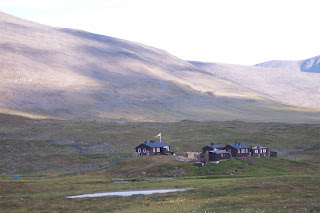
Descending on the other side of the pass, even for the weary, looks like a synch. With every step the wind softens. It is still no short walk to Salka, and our legs and feet become shaky as the day progresses. As we descend further, we find ourselves walking through patches of meadow in the crushed rock ground. Downy cotton-ball flowers, scattered in the grass, lean away from the breeze like windsocks. The green hills to the West and the red-brown hills to the East grow taller. In the distance a powder blue ridge cuts a jagged horizon. Clouds race above our heads, their shadows drifting like jellyfish over the grassy valley.
Salka appears suddenly. It consists of five brown wooden building with a sauna and a welcoming stockpile of split wood. Behind the main bunk house a patch of purple flowers rolls down the embankment to the river close by. We drop our packs outside the door of the main building and enter the store for provisions. I pick up a Sixteen-ounce can of meat balls that might pass for dog food back home. Here they could just as well be rib eye steak. We pay the hut mistress, a blonde 22-year-old knockout as we hobble, there's no helping it, to the kitchen.
I can’t say enough about the comforts of this place. Dinner is delicious. Of course, after a 15-mile hike, almost anything would taste good. I am sure that my endorphins must be playing tricks on me, but I am so happy I could almost burst. After I wash my dishes and empty the slask, I pitch my tent by the river, almost certainly in a flood zone, and head for the store to barter for a sauna ticket. The Salka staff is friendly. They are glad to trade me a ticket for some tuna packets that I am tired of carrying. They point me toward an outbuilding at the edge of this little settlement.
In front of the sauna building there is a small porch with three pair of boots. I take off my Crocs® and enter the anteroom. The yellow pine walls are lined with hooks. Wrestling with the remnants of my Puritanical sensibilities, it takes some steeling of the nerves to leave my clothes hanging and walk naked into a room of full strangers. My movements are mechanical, awkward and shaky even though the air is quite comfortably warm.
Before the steam room one enters a rustic washroom, empty except for three buckets, a broom and a ladle. There is a drain in the floor. Through the window in the sauna door I can see nothing at all so I take a deep breath, open the door and step inside, hoping with all my heart that I won’t be severely underdressed.
On the benches in front of me, like an audience, sit two young men and a woman. I smile with relief, noting quickly that everyone else is as naked as I. They greet me like a friend. I am immediately comfortable with them. Adolfus is a high school student hiking with his father, who is already sleeping in their tent. He sits on the top tier, politely quiet. The other two are a couple in their young twenties. Erik has long, fair hair and a scraggly, bearded chin. He leans against the far wall, one knee to his chest, carefree and unabashed. Emelie, his attractive, dark-haired girlfriend, sits apart from him on the second bench from the top. She leans forward with her hands at her sides and her shoulders hunched up, relaxed and unselfconscious. It is a healthy, fine-figured group, and I can’t help thinking that, aesthetically, I bring very little to this table. Still, they welcome me in perfect English and put me at ease with their self-confidence.
After Erik demonstrates how to fill the boiler on top of the stove and stoke the fire below, we find many other things to talk about. Erik and Emelie are avid hikers, having done many of the famous European hikes together: the Haute Route through Switzerland; several treks in Austria and Italy; the St. James’ Trail through the Pyrenees and others. They have even hiked the Inca Trail in Peru. For their age, they have covered a lot of ground. They plan, next summer, to hike in the mountains of Corsica.
Soon we are chatting away as if sitting at a backyard barbeque. Erik and Emile explain that they work all winter in group-homes with the disabled. It pays well, provides room and board, and allows them to save all their money for six months at a time. Then they travel for the other half of the year. They tour on a shoestring budget and this sauna is a luxurious splurge. They have made the best of it, though, sitting here for two hours already.
Adolfus mostly stares at the floor. I ask where he is from and he says outside of Stockholm. That seems to be everyone’s answer. From his shy downward stare, it is clear that, even as a Swede, sitting naked in a sauna is still a bit awkward for him.
The young couple suggests that I join them in a sprint and a dunk in the icy stream. Determined to experience every aspect of this Kungsleden ritual, I agree with a lump in my throat. I know, from experience, that the water will be frigid. We are higher up now than my first swim and the idea of going from one hundred fifty degrees to thirty-five seems a bit edgy.
They sprint out the door and I follow behind, miscalculating the wetness on my feet and the slickness of the porch. Wham! Down I go, right on my tailbone. I sit there for five seconds, stunned but uninjured.
“Shit! Are you alright?” Erik asks.
“Yeah, fine.” I say, not really certain, and we laugh it off, walking more carefully to the rushing stream.
“This is a deeper spot. You have to lie down right here.” Emelie explains. I hesitate -- but what the hell, I’m already naked with strangers in the arctic, red as a lobster and standing in ice-water. Why not?
Emelie is, by now, lying on her back, completely submerged -- a rippling sprite, in an icy-cold bed. Erik joins her in a backward plunge. I hold my breath and do the same.
The water, in a frigid embrace, wraps around my body. My skin tightens like shrink wrap. All I can hear is churning crushed gravel. My heartbeat has stopped I think. Will it start again? I lay under the water for what seems to me a very respectable split-second then sit bolt upright and scramble up the bank.
“You didn’t stay in long enough!” Erik shouts.
“Long enough for me!” I reply over my shoulder as I jog back to the sauna.
After steaming for another half hour we call it a night. In the washroom I ladle warm water over my head and then dry off with my small hand towel. Aside from clean under shorts, all of my clothes are now dirty. Still I’m warm and relaxed and ready for bed.
 Day 4
Day 4 It is my fourth morning of oatmeal with raisins and powdered milk. The tea is the highlight of the meal. I never get tired of tea. At home I rarely get tired of oatmeal but today I’d kill for an omelet.
Over this breakfast, cooked in the warmth of the bunkhouse kitchen, Charles and I agree to hike another double leg, bypass Singi hut and head straight for Kaitumjaure. It has been our plan from the start to cover as many miles as we can safely cover. Today we had scheduled another two sections and we are both well-rested and eager to try.
As we start down the Kings Trail again I glance back and wonder if this day can possibly beat the first four. Five minutes beyond the last building I see Erik and Emelie breaking camp by the river. Emelie is wearing a wrap-around skirt, an old woolen sweater and a red scarf over her hair. Erik’s long hair is braided down his back. Clothed they look like a pair of gypsies, which surprises and amuses me. We exchange smiles and a wave, and I realize that Hans was wrong. Erik and Emelie are as friendly as any Americans. I regret not having asked for their email addresses last night but it seemed oddly forward, given the circumstances.

We entered the green Tjaktjavagge, when we crossed the Tjaktja pass yesterday. From context I realize that “Vagge” must mean valley in Lapp or in Swedish. This morning, blue-gray clouds blow down from the glaciers to our east. Rain threatens and I am glad we are over yesterday's hurdle. But will we make Kaitumjaure today? If the weather turns foul, we may have to sleep at Singi.
Singi has no store. To cut down on pack weight, I traded three pounds of food at Salka and left another seven pounds in the kitchen cupboard. If we don’t make Kaitumjaure, I will need to break into “emergency” rations. I’m hoping for my new favorite dinner, canned Swedish meatballs, so I‘d rather not bother with Singi.
The landscape is all moss and grass, and the path winds through miles of rolling, primeval fields strewn with rocks and low bushes. For four days we’ve wandered through caribou country with hardly a sign of a reindeer. This morning they finally appear. Within the first hour we spot a small herd up ahead to the west. I put down my camera and zoom in on three reindeer who stare back at me. I get my fuzzy trophy shot before they scatter.
Pausing, I swallow two aspirin. My right ankle may just be mildly sprained. Could I have twisted it yesterday outside the sauna? I tighten my right boot to add some support, careful not to aggravate the healing bruise from three days ago. I console myself with the thought that every day on the trail always brings some new pain. By the end of today I should know if I’m in trouble.
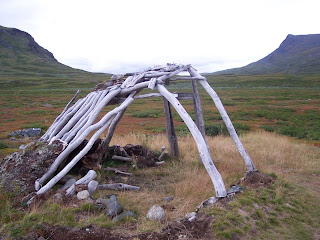
The stark, grey scenery distracts me from the ankle. There’s a faded red blaze on a rock with an antler leant against it. A bit later I see a pyramid of branches, like bleached bones in the sun, the skeletal remainder of an old Sami hut. Nearby we find a pile of eight antlers. We pick them up, rearrange them and leave them for somebody else to discover.
Along this stretch of the Kungsleden, the mountains and glaciers are supposed to be quite beautiful. Unfortunately we see very little of this “roof of Sweden”, catching only rare glances through the clouds. We can barely recognize Kebnekaise, Sweden’s highest mountain, to our left. Many of the hikers we’ve met will be heading that way, over Kebnekaise’s peak, while we continue south for at least another five days. If we bypass Singi today, we’ll be at our half-way mark.
From Salka to Singi the distance is only about 7 miles. The weather still threatens but the walking is good and my ankle is bearing up. We reach Singi by 12:30 in light drizzle and swarming mosquitoes. If I briefly consider staying, that thought fades quickly when we confirm that there is no food for sale. It is still early, the bugs are outrageous, and there is nothing to tempt us to stay.

It should be another 4 hours, about 8 miles, to Kaitumjaure. After a five minute break, and two dozen mosquito bites, we hoist up our packs. Several other hikers try to stop us from leaving. “It is too far” says an earnest young woman. “You should stay,” adds her boyfriend, “it is too dangerous.” We hear that a lot when we do double-legs -- especially in the rain. Once a person settles in for the night, the idea of some other hiker carrying on becomes unthinkable. So we’ve learned to just smile. To stay means ten hours of boredom. I’d rather be hiking.
There is something cathartic about a good, long walk. It is the best way I know to my worries behind.
Despite the hovering dark clouds, and the occasional ankle throb, the view grows more striking with every new mile. The birches have begun to turn yellow with the season, and the stubby forests are flecked with color. These trees are the edging on what has become an immense plateau rolling down to a vast blue river. The river has carved a broad valley between cliffs that stand like castles, layered into the distance, each bluer than the last, until they disappear around a bend.

The Kaitumjaure hut overlooks this dazzling scenery. We descend to the hut overawed. The rain now begins more in earnest and leaves us no dry spot to camp. A warm bed is appealing after three nights in a tent so we allow ourselves the luxury of an evening indoors and happily settle into the kitchen. Rejecting the meatballs for a well-deserved carbohydrate feast, I cook up a pile of spaghetti with pesto and complement it with reconstituted wild mushroom soup from the store. The soup is creamy and delicious and the spaghetti is satisfying. What it lacks in nutrition, it makes up for in calories. I’ll catch up on green vegetables next week.
The beds are equipped with rough woolen blankets but I prefer the comfort of my own sleeping bag. In the middle of the night I begrudgingly leave this luxurious warmth for the call of necessity. In the fog, my headlamp beam is a bright white light-saber. The air is cold, and the outhouse is dank and dark, making me think of a casket. The smell of cedar mingles with the sickly sweet odor of decomposing waste. Outside, the crickets chirp slowly; I finish as quickly as possible.
Jogging back, I slip on the damp stones. I have to stop doing that.
Day 5 Instead of breakfasting at the hut, we get an early start and hire a lonely ferryman to motor us across the river. He drops us at a listing pier on a rocky beach, then returns to the opposite shore. Charles fills his bottle from the river, and we snack on Wasa crackers and reindeer cheese.
The river and sky are crystal blue today. The storm has passed, leaving the air crisp, clear and cold. It is our goal to make Saltoluokta Tourist Station by the evening but we are handicapped with the necessity of crossing three rivers. To make matters more difficult, we must take a bus from Vakkotavare to our final river crossing. It is a long shot but Saltoluokta is the pearl of the Kungsleden. There is a sauna, hot showers and a restaurant reputed to serve unforgettable meals.

The beach backs up to a steep cliff up which we must climb. It is slow going at first but once over the top a deep blue sky and cotton ball clouds drift over our heads. Before us, a topographical map of mottled green, grey and brown stretches almost as far as the eye can see. There is hardly a tree, and fresh snow fills the hollows of neighboring hills.
We reach a small hut called Teusajaure and try to cajole the surly hut master into taking us across the next river. He eyes us warily and says that he can’t make change. We pool our odd Krona coins and scrounge out our fares to the penny. With a begrudging mumble he finally agrees, tossing down his broom in a gesture of sulky contempt.
With all of these rivers, I am glad that motor boats have come to the Arctic. I cannot imagine rowing across, like the outdated Kungsleden guidebook suggests. Often the trail on the far side is miles upstream. And today the wind blows in angry gusts across the water.
Above the ledge on the far side of the river, the scenery is lonesome, fantastic and vast. A range of triangular mountains appears, their peaks rise like teeth from gums of enormous glaciers. They seem to lie below us but this is clearly an optical illusion.

By lunchtime we realize that the hiking is taking longer than we foresaw. I become more eager to make time but the hours keep passing on this endless, rocky plateau. Trekking today is like a dream where I’m running in place. In this middle-of-nowhere land, the Kungsleden is sometimes hardly more than a nervous groove cut through the thin topsoil, or a strip of exposed stones with occasional cairns, like lighthouses in a wide green sea. There is no sign of an end, only miles of mossy landscape with the occasional stunted tree or shallow blue pond.
Charles has been walking more slowly today. Every day so far he has led our hike. Now I find myself standing on elephant sized boulders, squinting back to be certain I haven’t lost him in all this vast tundra. The random stones grow larger still as he falls further behind. I climb to the top of a monstrous one, the size of a two storey house, and lie there to wait for him.
When he finally appears he is visibly pained by a twisted ankle and knee. We decide to stick together for the rest of the day and are finally rewarded with a view of the next enormous river from the end of the plateau. I don’t take much time to appreciate the scenery. Instead I make a headlong run down the embankment to see if we can still catch the bus. I jog full-tilt down the brown, rocky trail. This is stupid and reckless, especially given the uncertain state of my ankle, but the thought of a real tourist station, a hot shower and a gourmet meal makes me completely irrational.
At the bottom of the hill sits Vakkotavare like a double-wide trailer by the side of the road. I throw off my pack, struggle out of my boots and stumble through the door, sweat rolling down my face. “When is the next bus?” I ask the startled hut master.
“Not until 11:15 tomorrow morning,” he replies. “Why are you in such a rush?”
I explain that we are eager to get to Saltoluokta and I realize, too late, that he takes this very personally. “Why don’t you want to stay here?” he asks, with an edge in his voice.
From there things just get worse. The man seems almost eager to take offense. He deals with us curtly, appears sulky when we say that we’ll be sleeping in our tents, and retires to his room before we even make dinner, leaving us with curt instructions about cleaning the kitchen when we are done. In his antisocial behavior I recognize signs of alcoholism and Charles agrees. But this doesn’t make it any less awkward.
By the time we have cooked, eaten and cleaned up, it is spitting rain outside. I crawl into my low, damp tent and read myself to sleep – awakening at midnight to realize that we forgot to take out the slask.
Day 6 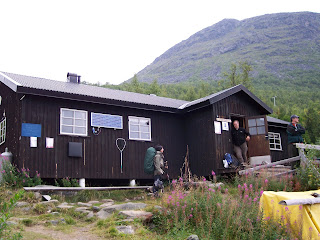
Early the next morning we rise from a sleepless night and enter the hut to cook breakfast. The warden sits in a rocking chair by the crackling wood stove and seems hardly to notice our arrival.
During breakfast a young German woman arrives and the tension is momentarily broken. She has been alone in the mountains of arctic Sweden for the past ten days. She speaks fluent English but Charles prefers to practice his German so the two of them chat while I read. Lapsing back into English they talk about similarities between German and Swedish, and Charles remarks that sometimes he understands Swedish words and phrases because of this. At this point, the warden stands up abruptly and says to Charles “I want to show you something.”
We are all a bit surprised by this sudden activity from the otherwise taciturn warden. Charles shrugs, I put down my book and we all pause and wait for the man to emerge from his room.
The warden returns and sits down close to Charles -- too close by North American standards. Charles is sitting on a bench behind a table with walls both to his right and behind him. Now he is awkwardly cornered, the hut warden blocking him in.
The man opens a large book, written in Swedish, and begins pointing to phrases on the page. “Can you translate this for me?” He asks. “No” replies Charles. “What about this?”
Turning page after page, the warden continues with this bizarre interrogation, confirming again and again that Charles cannot easily translate this book from Swedish to English.
Finally Charles’ patience wears thin. “Why are you asking me this?” he says.
But the quirky warden persists, as if he does not hear. He flips through another few pages and Charles, who stands 6’4” and weighs at least 200 pounds, now looks about ready to flatten him.
Suddenly the warden stops, closes the book and looks Charles directly in the eye. “You said that you could understand Swedish.” He says, “I wanted to see if you really could. If not, you should not have said it.”
There is a silence and I am frozen, waiting to see what will happen next.
“Get out of my way.” Charles says standing up, almost knocking the man off of the bench.
The warden stumbles backwards and lets Charles pass. “Take it the right way.” He says, realizing, too late, that he has pushed things too far. “Take it the right way.”
Charles grabs his backpack, throws his pots and pans into a plastic bag and storms out of the hut. The lunatic warden is still begging Charles to “take it the right way” as the door slams shut.
I follow Charles, scrambling to gather my own things.
“What the Hell was that?” Charles exclaims as I catch up with him near the road.
“I have no idea.” I reply. I have never seen Charles so angry.
The bus ride is longer than I had anticipated. Half way through we stop at a small shop with a diner-style restaurant and trinkets for sale. I buy a cold Coke and a donut, thinking I’ll treat myself to some refined sugar, but they taste disgusting. I end up drinking my water instead.
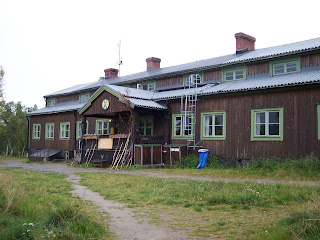
The bus line terminates near a rustic boat landing. We walk down a short drive where a crowd of tourists is already queued up. If they are waiting for the boat, it’s going to be a crowd. As it turns out, they are waiting for the bus.
We negotiate the fare with some clumsiness but no real trouble. It is run by Samis who speak no English. It seems we’ve discovered what the remaining natives are doing when they are not herding reindeer.
Charles reports that his ankle and knee are feeling much better. He will be ready to hike again this afternoon. We can stay nearly on track if we get moving again directly after lunch. Staying at Vakkotovarre last night has set us back at least half a day. We have some time to spare but we had hoped to use that time for further hiking.
From the far side of the lake it is a short walk to Saltoluokta. We are just in time for lunch, an unbelievable all-you-can-eat buffet of poached local salmon, asparagus, freshly baked bread and a drink made from the juice of local berries. Perhaps it is just our recent trail food diet but Charles agrees that this is some of the very best fish either of us has ever eaten.
With full stomachs and a taste of the local comforts, we consider the possibility of staying for the night. We enquire about a room and discover that beds can be had for 270 kronor, about $40 dollars. The young man at the desk says that we should be able to have a room to ourselves. It is too tempting to resist. “Can I pay in advance?“ I ask, but the desk clerk prefers that I pay after dinner. The total cost can’t be calculated as of yet. It is an odd system, considering that the dinner appears to be prix fix, but I don’t argue.
Charles insists on paying in advance and decides to skip dinner. Charles likes his peace and quiet and we often split up at times like these. I like hiking with him because he takes space for himself and gives me mine. I once told him that hiking with him was like hiking alone. I intended it as a compliment but it didn’t really sound that way I guess.
Our room is painted with layers of white chipping paint. It reminds me of a hostel room, with six wooden bunks and a beat-up pine table. There’s a gas stove in the old fireplace and we soon have it cooking with sink-washed clothes draped all around. It is not spacious for six, perhaps twelve foot by sixteen, but it is a corner room with windows on two sides looking into the forest and, as promised, there are only the two of us.
After the wash-up, I go to take a Swedish sauna. It is not co-ed, unlike the sauna at Salka, and my only companion is John, a sad, middle-aged man who tells me that he’s been wandering with only a tent, a compass and some dried food for the past ten days. During this hiking he has seen no one, so this is his first conversation. He is taking some time off from caring for his wife, an invalid, who needs complete assistance. She was paralyzed several years ago. He describes how he took her on one final hike after her accident. He alternated between carrying his backpack and carrying his wife. His greatest guilt, beyond leaving his wife at home, is his neglect of the garden. She always cared for the garden and he has no knack for it. So it has gone to weeds and he wishes he could find someone to tend it for him.
It is a pitiful story. I feel very sorry for John but his company is making me depressed. After a half an hour of this monologue I politely excuse myself, take a nice cool shower and go in search of a quiet place to write in my journal.
In the main foyer there is a fireplace with an empty rocking chair and a wide hearth upon which to warm my feet. I make myself comfortable but have no sooner settled than I am joined again by John who, clearly, did not take the hint. He still wants to talk, and the fact that I neither put down my journal nor my pen does not stop him from starting up right where he left off. He seems to think that I can advise him on how to live with perpetual bereavement. So I put down my journal and listen. I suggest that he needs to get out more often and hike, perhaps, on well-traveled paths, for the camaraderie if for no other reason.
“But this is how we always hiked” he says. “We always hiked in the wilderness, not with other people.”
Hiking has become a penance, much like the rest of his life. His is a hard lot and enough to make the strongest man miserable. So I listen for two more hours, then it is time for dinner. John is not eating dinner in the restaurant so I am at last free to find some new acquaintances.
I sit at a large table with seven other guests including three young women from Stockholm and a sixty five year old man who started the Kungsleden alone but has bonded with them in a grandfatherly sort of way. For the past eight days this foursome has been hiking together. They are all fast friends and I, the odd man out, receive a polite but lukewarm reception.
The dinner, however, is perfectly done. It starts with a salad of wild greens, slivers of pickled onion and fresh tomatoes. Next is the main course of caribou with capers and scalloped potatoes. The caribou has the flavor of an excellent beef but with the smooth texture of calf’s liver. For dessert there is a wild berry crumble. With every bite I am thrown into ecstasy. I couldn’t care less about the cold company; I am in heaven. If I ever have the chance I will return to Saltoluokta, the Valhalla of long-trail hikers.
When I return to the room, Charles is already asleep. I check the dampness of my socks, rearrange them to get the full benefit of the stove’s warmth, and quickly fall into blissful sleep.
 Day 7
Day 7 The next morning is a total disaster. Each of us finds a way to anger the hut staff. They are like Jeckyll and Hyde, these people. The same young man who encouraged me to wait and pay last night (the window was closed) now berates me for trying to pay too early in the morning. It seems that the office doesn’t open until after breakfast has been served and cleared. We, however, would like to get going at 8:30. This puts him out in no small way. He makes no attempt to hide a fierce temper, slamming the register drawer and turning his back to my apologies. Then, as we are on our way out, Charles gets in trouble with another young man for walking to the bathroom over a freshly-washed floor. Service with a smile is not to be taken for granted in Sweden.
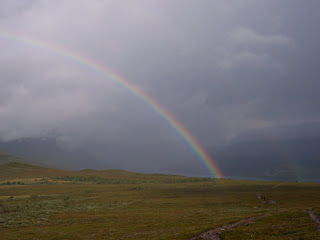
The day continues to disappoint with a terrible deluge. The Kungsleden is a wet, sloshing mess, the only redeeming feature of which is a beautiful double rainbow. We see little else through the pouring rain and cut our hike short at Sitojaure. This throws us off our goal even further. After making great time for five days, we are now falling behind. Still, there is a silver lining in this cloud in the form of two new friends.
We meet this wonderful couple at Sitojaure, Olivier and Claudia. They are from Munich and speak beautiful English. They are young professionals and avid trekkers, hiking in Sweden for the first time. Olivier is tall, athletic and rosy-cheeked. He wears his headlamp through dinner although, with the candlelight, he never turns it on. Claudia has dark-hair, pretty brown eyes and a slightly pointed chin. The four of us are the only visitors at Sitojaure and we soon feel quite at home with each other.

When the rain lets up a bit, I take a walk to a Sami village on the rumor that an old hermit there might have some reindeer meat (caribou) to sell. The “path” takes me trudging through waist-deep flood water. The Sami man is irritable and speaks no English. He looks like an aging Eskimo, lives in a tiny shack and just shrugs, uncomprehending, when I try to explain what I am after. I desperately try to pantomime the eating of reindeer but he is clearly unimpressed. Luckily, my hut warden is not far behind and helps me with the transaction. The meat is frozen, packed in reused plastic containers and stored in a chest freezer. His electricity is a mystery as there is none in our hut and no wires to be seen… perhaps they have solar panels somewhere?
I return with nearly four pounds of stew meat which Charles and I fry up in heaps. There is too much for dinner so we save the remainder for breakfast. We eat by candlelight with Olivier and Claudia’s conversation to entertain us. We sleep inside because the rain is far too heavy for tenting. It’s all very cozy, though, and I do not regret the expense. I am getting used to these creature comforts. If I ever hike the Kungsleden again I might just leave my tent at home.
Day 8 It is a blue-sky day but cold. The air has changed with the storm and it feels like we’ve gone from summer to winter in twenty four hours. It is pointless to hike further than Aktse today because, having fallen behind schedule, we must end our hike at Kvikkjokk. We had intended to camp our way across the vast no-man’s land after Kvikkjokk but we no longer have time in our schedule. And although we are both now in reasonably good health, the recent bad weather and ankle twists has given us pause. If we ran into trouble on that stretch of the Kungsleden, the result could be the end of one of us.
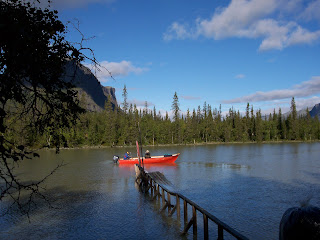
After breakfast, the four of us hustle to the river and, because of the flooding, have to trudge through some water to get there. The tiny ferry landing is out of commission, completely under water. Instead, our ferryman has pulled his several boats well up onto the shore. It takes three of us to shift the boat from the beach with icy water pouring into the tops of our boots. The boat is alarmingly small for the five of us. I am thankful for the life jacket provided by our host as the boat leaps the waves that rise up against the brisk wind.

On the far shore Charles and I split up as usual. Olivier and Claudia hike together. Periodically we leapfrog each other but Olivier and Claudia are strong hikers and end up mostly ahead. The scenery is becoming somewhat less picturesque - long stretches of moss and rock with few dramatic touches. Or perhaps we are just growing weary. We have a river to cross in the morning and another river in the distance. But we’ve seen so many rivers already. If it were not for our new friends, there would be little to remember of the day.
It is a short hike by our standards, only five or six hours, and we arrive at Aktse to find an empty hut. There is another couple waiting for the store to open and they tell us that the wardens have gone to assist someone with a broken radio. This turns out to be an unfounded rumor, however, because the couple returns an hour later from a day-hike. No radio problems at all. They are both very pleasant and welcoming, curious about what brings us Americans to this part of Sweden. The woman has been to New England, where we are from, so we have something to talk about as I shop for my dinner. The husband has rigged up a funky, makeshift shower which he welcomes us to try. The water is cold but it’s not to be missed by a man in my current condition.
Charles decides that he is going to sleep outside again tonight. I am too addicted to the creature comforts. I no longer feel any desire to sleep on the ground. I settle myself into a bunk and read for several hours before dinner. Olivier and Claudia also decide to camp out so, in this 20-person hut, I am almost alone. I am, however, joined by one other man who soon has my gall rising. He over-stokes the fire, fiddles with his hands and, when Charles appears for dinner, informs him that he’ll be watching the clock. “You only get two hours in the hut if you’re camping out. When you’re done with your dinner you’ll have to leave. Those are the rules.” Why he should be so exclusionary in a big empty hut is incomprehensible. His attention to detail spoils what might otherwise have been a very pleasant evening. Irritated, Charles leaves as soon as he’s done washing up. It is beginning to feel like there may be a high rate of insanity among Swedish male solo-hikers.
I retire early, shutting my door to the heat as the cast iron stove glows red.
 Day 9
Day 9 In the morning I make plenty of noise with my breakfast, hoping to get some revenge on my still-sleeping companion. He rises, ignorant, and tries to make conversation. I ignore him and pack up my things.
There is another river to cross this morning, again with Olivier and Claudia. Shortly thereafter we plan to split. Charles and I are trying for a marathon trek. We hope to reach Kvikkjokk in a double-leg hike that will take us over 24 miles to the end of our journey. I am completely recovered from my ankle injury, and Charles is feeling 95% better.
The boat drops us off at yet another submerged dock. We make it to shore mostly dry and hike up to the day’s plateau. Claudia and Olivier say goodbye and then hang back as we pick up speed. They will be staying at a hut half way to Kvikkjokk. We do not expect to see them again.

For the first half of the day, Charles and I stick together a bit more than usual. Although we are both eager to leave the Kungsleden and get back to the comforts of civilization, we realize that our adventure is coming to an end. It may be years before we hike together again. As a new father, Charles is feeling guilty about being away for so long. I am also liable to have a child in the next year or two. There is no telling what impact that will have on my own urge to hike so far from home. So we find more time to talk, going over our vacation, its ups and downs. We have encountered a diverse array of characters and scenery, some of each likeable than others but, as a whole, defying generalization. We have felt warmly welcomed in some places and misunderstood in others. We have experienced camaraderie and solitude, spectacular scenery and dull monotony, extreme pleasure and, also, anger. It is said that the arctic is a region of extremes. This is certainly true of arctic Sweden.
After several hours I begin to take the lead. Charles falls back as we pass under a rocky cliff. The views are, again, quite beautiful. I appreciate them more keenly, knowing that this will be my last day on an arctic plateau. In the distance below us is yet another river. We begin our descent and soon the ground becomes marshy and forested.
By the time I reach the turn off for Parte hut, Charles is nowhere to be seen. I set my pack on some planking at the turn-off and wait, sitting on my pack with my bug net over my hat to shield me from the swarms of mosquitoes. After twenty minutes, Charles appears around the corner, limping slightly but making a strong effort.
“You had better go ahead and reserve us a room,” he says. “I’m not going to move any faster.”
I am concerned about going ahead without him but we have a policy of not second-guessing each other. He has camping equipment and is perfectly capable of bivouacking for a night. If I don’t see him by morning, I’ll go back for him. “OK, I’ll see you there.” I say and start off again as quickly as I can walk.

This second leg is another six hours, minimum. This time much of the hiking is through conifer forest, and the trees grow more sturdy as I get closer. I am single-minded now. My thoughts are on a good meal and a pint of lager.
My pack has grown lighter over the past several days as I have either ate or left behind the remainder of my food. Each of the huts has a cabinet in which hikers leave non-perishable foods that they no longer wish to carry. I have scattered my supplies between three or four huts. It is amusing to think that these items traveled from Providence, Rhode Island all the way to arctic Sweden only to be left behind for strangers. Perhaps they will marvel at price labels written in dollars. Given the cost of food in these parts, I have no doubt that they will all be eaten.
It is 7:00PM when I finally enter the courtyard of the Kvikkjokk fjällstation. I arrange for two beds and then make my way to the restaurant for my last meal on the Kungsleden. It is only then that I realize how exhausted I am. My legs, limp and wasted, barely carry me up the stairs.
I drop my pack in a corner, noticing only one other table of guests. The bar and restaurant are informal but adequate, and I have a view of the trees and the sunset from my seat. A dark haired young woman takes my order. She is pretty and fit, like most Swedish women. She stands in the doorway of what appears to be a closet, and somehow cooks the entire meal in this claustrophobic space. I get a burger, fries and a Bass Ale to wash them down. The restaurant is closing soon but she is very considerate, allowing me to eat and relax while she cleans and shuts down. This is not Saltoluokta, but I would rather eat a burger from this kindly young woman than a gourmet dinner from an angry staff of twenty.
Charles is an hour and a half behind me. I am relieved to see him pass through the welcome arch. We meet in the courtyard and both head straight to our beds. Tomorrow we will sort out how to get ourselves back to civilization.
Copyright 2009. All rights reserved.


 Posts
Posts


