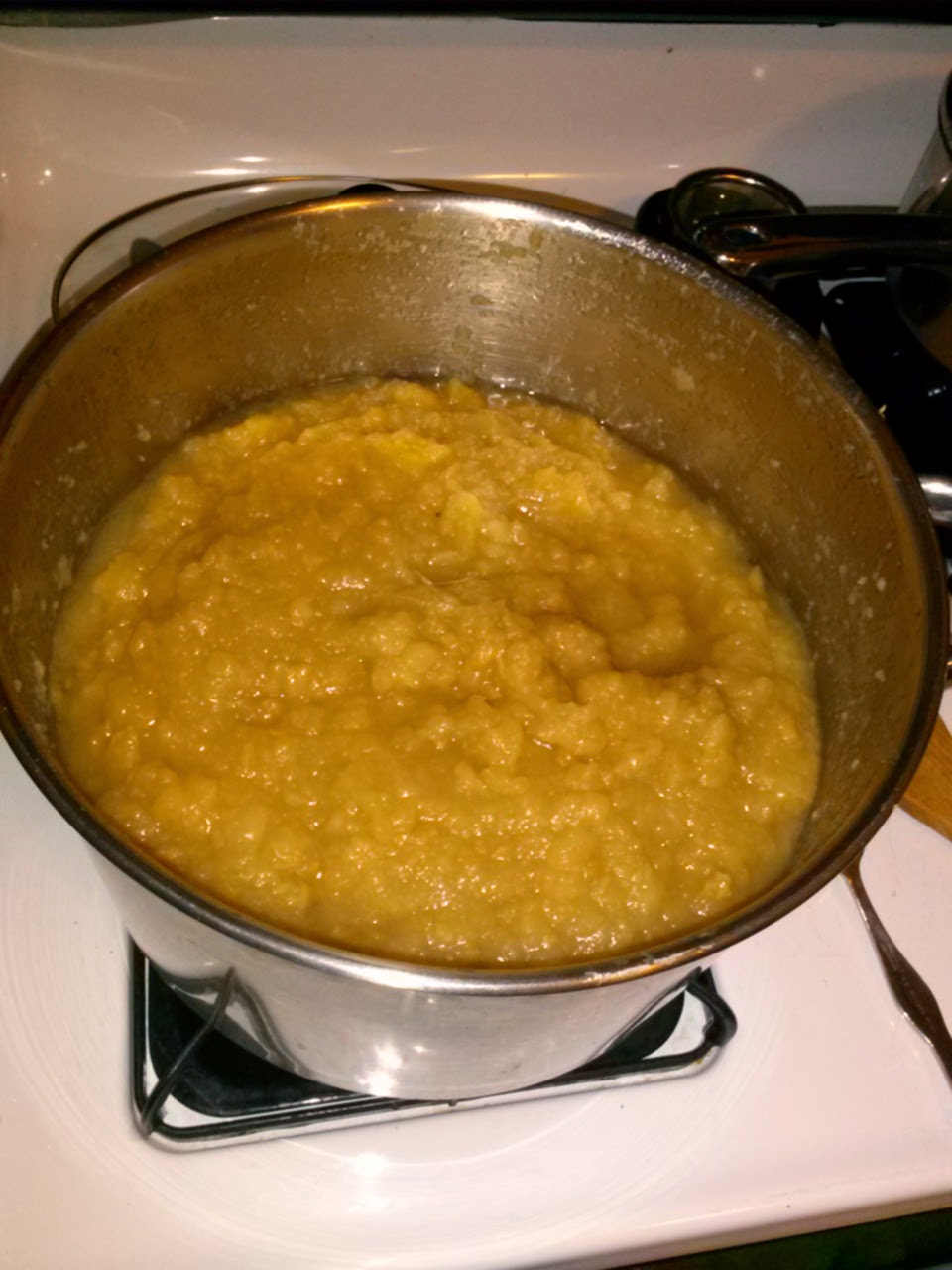
In Cindy and Karen's yard there are two apple trees that bear many hundreds of seemingly unimpressive, fruit. Waxy, hard, slightly acerbic, and often imperfect, this burgundy red fruit can hardly be called a "table apple" when freshly picked. What is truly amazing about this heritage breed, however, is that, two months after the tree is cleared, the apples have ripened to an amazing sweetness. It is these apples that are my preferred choice for my yearly apple sauce.
Not only are the apples free (thanks to the generosity of my sister, Cindy and her partner, Karen) but are also easy to handle. The sweetness of the sauce needs no sugar, even by store-bought standards. The apples that survive this long are often still firm enough to be easily peeled and cut. Most have some pest damage, as would any home grown, organic apple, stored for two months, but many are clear enough to slice, peel and eat fresh without squeamishness. The natural wax they exude makes the skin feel almost greasy, (I am not excited about eating the skin) but this wax also serves to protect the apples while they complete their ripening.
So this is how I spent the greater part of my afternoon: peeling apples and boiling them down. I added nothing to the sauce, and am so impressed with the result that I would gladly peel and boil another bushel. But I will have to be satisfied with two gallons of sauce for there are, alas, no more.
This happened to us last year, too. Then in March, when we began to run short, we savored the final pint, wishing we had taken the time to pick a few more when we had the chance.
Thank you Cindy and Karen!
-------------------------------------------------------------------------------------------
Thursday, December 4, 2014
Sunday, October 26, 2014
Autumn Olive Adventures
![]() |
| Autumn olives begin to ripen, September in New England |
Autumn in New England, what to eat? Wild apples, Concord grapes, several varieties of mushrooms, not to mention the wide selection of fruits and vegetables available from our gardens and farm stands.
In the past, I have often focused on hunting for hen of the woods mushrooms in the early fall. Last year there were so many that we literally didn't know what to do with them all. I had a full freezer, pickled mushrooms in the pantry, dried maitake in the cupboard. In anticipation of another harvest, I only recently tossed my last frozen block of sautéed hen of the woods soup stock. Little did I know...
2014 has been a terrible hen of the woods year for me. Maybe I just got my timing wrong. Or perhaps it was the dry August, or maybe the warm September but, for whatever reason, these mushrooms were few and far between. One of my chef acquaintances verifies that he hasn't seen many maitake foragers this fall, one or two nice mushrooms, perhaps, but nothing like last year. The only mushroom I spotted here in Rhode Island was at the bottom of an old oak in Roger Williams Park. It was along an infamous dog walking trail and showed signs of, well, you know what I mean.
The hen of the woods will be back another year.
In the meantime, I have turned my attention to a bounty that I had previously ignored almost entirely. And what a bounty! The autumn olive (or "autumn berry", as some aficionados are now rebranding it) is a small, red berry with a bad reputation. This tree is taking over the fields, wastelands and forest edges of New England -- as well as much of the rest of the United States. It looks much like many other decorative "bird berries", and grows so plentifully that it is almost impossible to imagine how tasty it can be!
The autumn olive, Elaeagnus unbellata (thumb.), was first introduced to the United States from Japan in 1830. This bushy tree, growing up to 20 feet tall, is capable of producing thousands of small red berries, possibly hundreds of pounds on a full-grown tree. The fruit is the size of a wild blueberry, the shape of a tiny cherry, bright red in color and speckled with tiny silver dots. Berries are easy to pick, growing in generous clumps along branches. Berries start to ripen in early fall. Some trees ripen earlier than others. Some trees remain viable well into the winter. Sometimes one side of a bush will ripen earlier than the other side. When picking, you should taste berries from time to time for sweetness, especially when you move to a branch with greener leaves or smaller berries.
The berry flavor varies from tart cranberry to sweet raspberry, depending on the maturity of the berry and the quality of the bush. Beyond taste, there is also this funny feeling in the back of the throat that takes some getting used to. This lessens with maturity and disappears entirely with cooking, but can be almost alarming in fresh or frozen fruit, feeling a bit like the beginnings of an asthma attack. If you don't like this feeling, never fear, just make jelly.
In my experience, the sweetest berries are found on trees with yellow, falling leaves. Fatter berries tend to be tastier, and berries are fatter after significant rainfall. Beware occasional thorns on smaller bushes. As trees grow taller, thorns disappear.
Autumn olive seeds appear to be entirely edible with no noticeable ill effects -- at least not for me. As with all new foods, try them in small doses to test for allergies. I won't argue with the purists who hold that most, if not all, seeds contain toxins, but I have personally consumed thousands of these seeds. I find them only slightly annoying. Seed consistency seems to vary slightly from berry to berry, some chew up nicely, some form into small, fuzzy clumps, and some leave behind tiny, woody bits in my mouth. Being used to wild foods, this doesn't bother me in the least. My wife and son are a little less adventurous and would rather spend $6 a pound on frozen, organic raspberries. Yikes! But when I make autumn olive jelly, nobody is complaining.
Autumn olives make a great jelly, as well as tasty fruit leather and juice. The product is reminiscent of cranberry relish or grape jelly, depending on the maturity of the fruit. Just follow any standard jelly recipe and substitute autumn olive berries for the fruit -- making sure to strain out the seeds after boiling the berries. Don't freeze the berries first or you'll have a hard time extracting the juice! The autumn olive has some natural pectin, but I generally throw in a couple of apples to be sure that it will jell properly. If you want to save time and get a more reliable consistency, use store-bought pectin.
I throw half a cup of frozen autumn olive berries into every smoothie I make and, admittedly, end up with those little, woody bits in the resulting, delicious, drink. If you don't mind that extra fiber, you're in for a very healthy, delicious treat.
Autumn Olive Smoothie recipe (vegan)
1/2 cup water
1/4 cup cashews
1 ripe banana
1-2 orange(s), peeled and roughly cut
3/4 cup frozen mango
1/2 cup frozen autumn olives
dash of vanilla
Blend until frozen mango is entirely pulverized
Add water or OJ to adjust thickness
As for health benefits, I consider the autumn olive to be a veritable super-food. Lycopene is reputedly present in significant amounts in this small, plentiful berry. Some claim that it makes tomatoes look like lycopene amateurs. The autumn olive also is reported to contain high levels of vitamin A, C and E, phytoene, a- and ß-cryptoxanthin, and ß-carotene.
![]() |
| Autumn olives, leaves turning, early October, Southern New England |
Also, please check out my new website: plant22.com. I am building a new web store, the profits of which will go toward reforesting the world. Look for our soft launch in the next couple of months.
References:
http://www.psa-rising.com/eatingwell/wild-foods/autumnolive.htm
Wednesday, January 2, 2013
Resolution Number 44
Happy New Year, all!
It's that time of year again. Resolution time! I'm no different from anyone else in that respect. In fact, this year I have two resolutions. One is pretty simple, the other is going to be a real challenge. In them, my friends will all recognize echoes of previous fixations. Nothing new here, just the same old me.
But, first, a little caffeinated musing on the old year, the new year and resolutions in general.
For my family, 2012 was a pretty rough one. The year started out hard with my dad in the hospital. After two months of intensive rehab, he was able to enjoy one last trip to Florida in March. The spring was pretty good, and we were cautiously optimistic that things might be changing for the better. As usual, my parents spent the summer on Cape Cod but, by then, my dad's situation had worsened again. He spent half of the summer in the hospital or in rehab facilities. By the fall, we were coming to terms with the inevitable. After a brief return to New Hampshire, he said goodbye on October 1, surrounded by his beloved friends and family. He was as kind and courageous in passing as anyone could ever be. We think of him every day.
I don't know if it was my dad's health or something else, but whole of 2012 seemed to drag on like a top-heavy wagon full of cow shit. I over-promised and under-delivered at work, not a good formula for happiness. My son had a really tough adjustment to Kindergarten. My wife had her own complaints. All in all, it seemed like the stars in 2012 were pretty far out of whack.
We are determined that 2013 is going to be not just a good, but a great year. I am in the process or buying a new investment property which promises to challenge me but which should, if well-managed, ease up our finances considerably. My wife is more settled in her career. My son has adjusted to school and, although it is still a challenge to get him up on school days, he is as well-adjusted as any other kid in his class.
Now back to the resolutions. My wife doesn't believe in them. I profess not to believe in them but, then, I always have a couple -- even if I keep them to myself. The odd thing is, I can't remember a single one from years past. I can imagine what they might have been. But that is not the same thing as remembering them. This year I am writing them down and intend to not only achieve them but to live by them.
I have been reading lots of self-improvement books lately. It's stuff that most of my friends would scoff at, and rightly so. Last month I reread Robert Kiyosaki's Rich Dad Poor Dad, a book that I can't help enjoying. I am now reading Think and Grow Rich by Napoleon Hill -- which reminds me a lot of How to Win Friends and Influence People by Dale Carnegie. The formula for goal achievement in each of these books can be summed up in three basic principles:
Each book offers suggestions for keeping on track: tell people about your goals; get friends to encourage you; associate with successful people; write out your goal out again and again, every day; put your back to the wall so that you have no choice but to succeed or go down in flames. In the end, it's the same as anything else: it all comes down to willpower. You must find, and maintain, the will to succeed. If you can't do this, you may just as well plunk yourself down in front of the TV with a dozen éclairs 'cause you ain't gonna make it, kid!
So what are my own goals for the year? One is pretty simple, the other is a game-changer:
It's that time of year again. Resolution time! I'm no different from anyone else in that respect. In fact, this year I have two resolutions. One is pretty simple, the other is going to be a real challenge. In them, my friends will all recognize echoes of previous fixations. Nothing new here, just the same old me.
But, first, a little caffeinated musing on the old year, the new year and resolutions in general.
![]() |
| Grandad and grandson under a towering lily at our cottage on Cape Cod |
I don't know if it was my dad's health or something else, but whole of 2012 seemed to drag on like a top-heavy wagon full of cow shit. I over-promised and under-delivered at work, not a good formula for happiness. My son had a really tough adjustment to Kindergarten. My wife had her own complaints. All in all, it seemed like the stars in 2012 were pretty far out of whack.
We are determined that 2013 is going to be not just a good, but a great year. I am in the process or buying a new investment property which promises to challenge me but which should, if well-managed, ease up our finances considerably. My wife is more settled in her career. My son has adjusted to school and, although it is still a challenge to get him up on school days, he is as well-adjusted as any other kid in his class.
Now back to the resolutions. My wife doesn't believe in them. I profess not to believe in them but, then, I always have a couple -- even if I keep them to myself. The odd thing is, I can't remember a single one from years past. I can imagine what they might have been. But that is not the same thing as remembering them. This year I am writing them down and intend to not only achieve them but to live by them.
I have been reading lots of self-improvement books lately. It's stuff that most of my friends would scoff at, and rightly so. Last month I reread Robert Kiyosaki's Rich Dad Poor Dad, a book that I can't help enjoying. I am now reading Think and Grow Rich by Napoleon Hill -- which reminds me a lot of How to Win Friends and Influence People by Dale Carnegie. The formula for goal achievement in each of these books can be summed up in three basic principles:
- Commit yourself completely, without reservations, to achieving a goal
- Learn everything you can about how to achieve that goal
- Work tirelessly, intelligently, and creatively, until your goal is achieved
Each book offers suggestions for keeping on track: tell people about your goals; get friends to encourage you; associate with successful people; write out your goal out again and again, every day; put your back to the wall so that you have no choice but to succeed or go down in flames. In the end, it's the same as anything else: it all comes down to willpower. You must find, and maintain, the will to succeed. If you can't do this, you may just as well plunk yourself down in front of the TV with a dozen éclairs 'cause you ain't gonna make it, kid!
So what are my own goals for the year? One is pretty simple, the other is a game-changer:
- Buy and renovate two investment properties in 2013. End goal: own 21 rental units by the end of 2015 (including the rental units in the 4-unit building we already own)
- Get my food budget back on track
Friday, September 7, 2012
Chicken Of The Woods / Sulphur Shelf -- Giving it a Second Chance
So, no hen of the woods in my part of Rhode Island just yet. My friends and I speculate that the dry summer weather has held them back. Fortunately, recent rains have inspired many other mycelia to fruit, including some very tender chicken of the woods mushrooms (see pictures).
As with all fungus, it takes a mycologist to predict the perfect weather. For instance, this morning I found black trumpets that had barely sprouted before developing a white mold. Disappointing. Too much rain, perhaps? I have no idea. |
|
Usually at this time of the year I would have more hen of the woods mushrooms than I could process. The smell would be hanging over our kitchen like a heavy blanket and my wife would be asking me just when she might get a break from "that stench". Last year was a banner year as far as hen of the woods were concerned. A hen in every pot. This year promises to be a comparative disappointment. Still, no need to let it get you down. Plenty of other mushrooms out there that still need eating.
This morning I rediscovered the chicken of the woods (aka sulphur shelf) mushroom. Usually I leave these mushrooms behind, considering them to be too tough to truly enjoy. Yes, they are perfectly edible but, with so many other spectacular mushrooms, I have rarely found a chicken of the woods that was tender enough to tempt me. Sometimes simply being edible just isn't enough. If it weren't for the lack of other mushrooms, I might have left this three pound beauty uninspected. I am glad that I didn't.
I found it under an old oak tree, right where I would have expected to find a hen of the woods. Aside from the distinctive, salmon color, it was a true hen look-alike. It was fresh, the outer inch (or more) of every leaf was very soft. The flesh was almost the texture of an oyster mushroom. It cooked up a lot like an oyster mushroom, too -- if I had added a drop of anisette, I might have fooled a blindfolded connoisseur.
I cooked up some of the outer, salmon colored flesh first, carefully carving it away from the tougher, orange stems. Some of these outer rings I tore into pieces and sauteed with olive oil, garlic and salt. I was delighted to note that it kept its wonderful salmon color. Were I a true chef in a fancy restaurant, I could have asked for nothing more beautiful with which to top a pasta. It tasted like, well, olive oil, garlic and salt -- with only the faintest hint of mushroom -- less even than the store-bought, button variety. Truly, the flavor of the chicken of the woods can hardly be called flavor at all. Still, the texture was fabulous and who doesn't enjoy any excuse to eat something that tastes like olive oil, garlic and salt.
Next, I shredded and sauteed some of the firm, inner, orange-colored flesh. It was, as its name suggests, very much like chicken in texture. Dry chicken. The kind of chicken you might be served at a lousy convention dinner, smothered in dubious brown gravy with reconstituted mashed potatoes on the side. I tried adding more olive oil and some water. It soaked up the oil like a sponge while the water steamed off. This helped the texture but who needs all that extra fat? So I tossed the inner mushroom. Happily, I was left with more of the good stuff than I will probably be able to eat.
It is hard to envision a scenario where preserving a chicken of the woods mushroom would be worth the trouble. Black trumpets have such a distinctive flavor -- and fetch such a famous price tag -- that preserving your surplus is an absolute necessity. I either dry and bag them or saute them and store them in olive oil. Hen of the woods mushrooms I preserve by either sauteing, shrink-wrapping and freezing them or drying and bagging. I've tried pickling oyster mushrooms but they end up slimy. Next time I think I'll just dry them and see how it goes. Chanterelles I never find enough of to preserve. But preserving a chicken of the woods seems a bit like preserving a button mushroom. It's best served fresh, like so many other things.
Thursday, April 28, 2011
Planning My Hike on the Alta Via II
The Alta Via II is an obvious choice for me because my last hike was the Alta Via I. Both hikes are in the Dolomites region of the Alps. They run parallel courses north to south through some of the most starkly beautiful and dramatic landscapes in Europe. While the Alta Via I offers World War I fortifications and labyrinthine mountain tunnels, the Alta Via II gives access to the largest remaining glacier in Europe on the tallest peak in the Dolomites the Marmolada. I will not be climbing its nearly 11,000' but will partially describe a circle around it and will probably take a cable car to the top. The height is not so daunting but the snow and ice make it a very technical climb -- more technical than my ultra-light, solo hiking will permit this year. Instead, I will take the sight-seer's option and ride the lift to the top. I am no longer too conceited to take a gondola.
It now appears that I will be making this trip alone. Charles probably cannot make it, despite my earlier posts. Regardless, I am committed to the hike. It has been too long -- almost two years -- since I've seen the Alps. I can't wait any longer.
Here is my itinerary as far as I can predict. Only the flights are set in stone. All page numbers refer to Collins, Martin & Price, Gillian (2002). Treks in the Dolomites, Cumbria, U.K.: Cicerone. "CAI" refers to the Italian Alpine Club, which runs many of the huts in the Italian Alps. They offer substantial discounts to members of certain other hiking clubs.
ITINERARY
Saturday, August 20: depart Providence, 11:33AM.
Sunday, August 21: arrive Venice, 9:25 AM
Train to Bressanone and an hour walk to San Andrea and Gasthof Gasserhof -- assuming I can get a reservation.
Monday, August 22
Gasthof Gasserhof to Rifugio Genova CAI p.80
Hiking Time: 5 hrs. + 2 hr. optional side trip to Sass de Putia, a nearby peak (8625 ft).
Lunch: Rifugio Genova, then turn around to do the summit (see below).
Half Board: € 35 (incl. dorm room + supper + breakfast)
Full Board: € 40 (incl dorm room + lunch + supper + breakfast)
Phone: +39 0171 978138
e-mail: gestore@rifugiogenova.it
Tuesday, August 23
Rifugio Genova to Rifugio Puez CAI p.85. No website, see here
Hiking Time: 7.5 hrs. including a variant from Forcella San Zenon (p. 82)
Lunch: Trioer Alm (4 hrs. from start) or Rifugio Firenze (4.5 hrs)
Half Board: unknown but probably similar to Genova
Phone: +39 0471 795365
Wednesday, August 24
Rifugio Puez to Rifugio Boè CAI p.91
Hiking Time: 7.5 hrs.
Lunch: Rifugio Piscadu (4:30 hrs)
Half Board: € 38
Bunk only (dinner not included): € 11
Phone: +39 0471 847303
+39 0462 602141
Remarks: Look for ammonites along the way
Thursday, August 25
Rifugio Boè to Malga Ciapela (a small town) p.100
Hiking Time: 6 hrs.
Lunch: Rifugio Viel del Pan (4:30 hrs.)
Accommodations: Will need to research hotels and make reservations
Phone: +39 0462 601323
Remarks: This is a small town. From here there is a 3-tier cable car to the top of the Marmolada, Europe's largest remaining glacier. A visit to the top is highly recommended but, perhaps, not super-cheap. Hotel Roy sounds nice with its sauna, turkish bath, etc. Half board is somewhere under € 50.
Friday, August 26
Malga Ciapela to Rifugio Passo (di) Valles a privately owned hut p. 105
Hiking Time: 6:45 hrs.
Lunch: Passo di San Pellegrino (4:30 hrs.)
Half Board: unknown – probably between € 35 and € 50
Phone: + 39 0437 599136
+ 39 0437 599460
email: info@passovalles.com
Remarks: Not much easily found info on this hut but the guide book recommends it highly. Being privately run, one should make reservations far in advance.
Saturday, August 27
Rifugio Passo Valles to Rifugio Rosetta CAI – p.111
Hiking Time: 8 hrs.
Lunch: Rifugio Mulaz (3:30 hrs.)
Half Board: € 36
Phone: +39 0439 68308 (only from 20 June to 20 Sept.) Alternate phone numbers below
Residence - 043968249
Mariano - 3470498929
Roberta - 3495331742
Remarks: no email. Consider ordering a bagged lunch for the next day.
Sunday, August 28
Rifugio Rosetta to Rifugio Cereda p.118 privately owned
Hiking Time: 10 hrs. mostly downhill.
Lunch: Rifugio Treviso (6 hrs)
Half Board: unknown
Phone: +39 0439 65030
email: info@passocereda.eu
Remarks: This is the longest day. Much of it is downhill which may or may not be a relief depending on the state of my knees. It could be split in two by staying at Rifugio Treviso. There is no great place for lunch before Rifugio Treviso so I may want to request a bagged lunch at Rifugio Rosetta. Also remember to order a bagged lunch for the following day.
Monday, August 29
Rifugio Cereda to Rif Bruno Boz CAI p.123.
Hiking Time: 7 hrs.
Lunch: There is no good place for lunch. Bring packed lunch and plan to stop at Bivacco Feltre. There should be water nearby.
Half Board: unknown
Phone: +39 0439 64448
email: mara.iagher@tin.it
Remarks: This is a small hut with somewhat limited facilities. I should make reservations in advance.
Tuesday, August 30
Rifugio Bruno Boz to Feltre (a town) p. 127
Hiking Time: 8 hrs
Lunch: Rifugio Dal Piaz (6 hrs)
Accommodations: hotel – make advance reservations either in Feltre or in Venice. Probably Feltre, given that I probably won't roll into town until mid-late afternoon.
Wednesday, August 31: bus from Feltre to Venice
Thursday, September 1: Flight from Venice to Providence
It's a bit of a tight turnaround at the end, not much time for sight-seeing, but this is probably for the best. I have visited Venice three times before and, as much as I love it, I don't need more than a day there after a 9-day hike. I have planned many hikes with too much R&R at the end. Time just drags. I once spent nearly a week in Stockholm after a trek in arctic Sweden. Stockholm is beautiful, don't get me wrong, but I was done after two days. I could probably take another day or two in Venice but it will be nice to have a weekend at home before the new work week begins.
Saturday, April 9, 2011
I Got My Tickets to Italy - Alta Via 2, Dolomites Trip,
So I got the tickets. For $236. And if that doesn't sound like an accomplishment, you haven't tried to buy tickets to Europe this spring.
Here's the punchline: I've wasted two years paying for the privilege to carry a Virgin Atlantic Black credit card. Turns out Virgin "miles" are more like kilometers: they only get you about 60% as far (or was THAT the punchline, ha ha -- yeah, hm...) Anyhow, you start out all optimistic because it only takes 35,000 air-miles to get to Europe. Doesn't that sound like a good deal? Well what they don't tell you is that the seats are severely limited; the only viable European destination from the Northeastern United States is London; the Boston to London flights are booked 6 months in advance; and you have to pay over $500 in taxes in fees to fly from JFK to London. I finally gave up and booked with my United miles and paid just $116 in fees to get all the way from Providence to Venice. So guess which card I'm canceling...
I am going to stop complaining now. After the booking contortions I should feel fortunate that I can even GET to Venice for just $116 in fees! And it is even remotely possible that I will be joined by my friend Charles, schedule permitting. You might remember him from our mutual misadventures on the E5 and on our arctic trek along the Kungsleden
I have decided to keep track of some of my planning on this blog. I haven't been using it very much and this gives me an excuse to post some plans for this summer and some reflections on my previous Dolomite trip.
The hike I will be doing is called the Alta Via II. I hiked the Alta Via I back in 2008 with three friends. I was leading the trip that year and, as much as I love to lead small groups of friends, I also really enjoy the solitude of hiking either alone or with Charles.
If that sounds weird -- I mean the "solitude of hiking with Charles" part -- you have to understand our hiking style. We both value solitude. During our first hike (the E5, mentioned above) we spent far too much time together. The close quarters nearly destroyed our friendship but the resulting detente gave us the foundation of honesty that has supported our friendship through many later hikes. Instead of hiking together, we hike in the same general proximity. This may mean that we won't see each other for several days at a time. Sometimes one of us will take an alternate route with no more than a "see you in two days." Occasionally we get together in a small town or a hut for a blowout dinner, the next day we may not even see each other. I once told Charles "Hiking with you is almost as good as hiking alone." I hope that he took it as the intended compliment but I actually misspoke. Hiking with Charles is much better than hiking alone because it gives me someone with whom to reminisce.
If anyone is curious how I got from Providence to Venice for $236 in the high season, it's all about the Chase United Mileage Plus credit card. There is a $60/yr. fee but, given the price of overseas flights, that fee easily pays for itself. I route all of my spending through this card and pay it off at the end of each month. As a result, I average over 25,000 miles per year just in spending. That's a "free" ticket every two years. Total cost, $236. Not bad when the same ticket would have cost me $1400 or more.
Thursday, February 3, 2011
Wednesday, August 11, 2010
Vic Chesnutt Rest In Peace
![]() |
| Photo borrowed from VicChesnutt.com |
Boy do I hate to be a downer after so many months of blogging silence but I had to post a belated tribute. I learned today that Vic Chesnutt, one of my favorite singer/songwriters, passed away last Christmas (2009). These days I am so far out of the loop on all things not directly pertaining to Ian (my son) that it took me this long to hear the bad news. Vic was a brilliant voice and a wonderful guy. I, for one, will miss him very much.
Vic was a musician's musician. While he never seemed to attract more than a small crowd, he inspired many other musicians. His music has been covered by so many performers that it seems pointless to list them. Even so, his gritty, unpolished style seemed to keep the mainstream from ever truly embracing him.
I had the pleasure of seeing Vic in concert perhaps three times over the past fifteen years. Needless to say, I am sorry to have been so inconsistent. You had to see him perform to truly appreciate his music. He was wheelchair-bound, due to an accident that left him partly paralyzed when he was 18 years old. I will always remember how, during what might be called an "intimate" show in New York City in the late 90's he seemed a little uncomfortable. His injuries clearly caused him significant ongoing pain. He asked the audience if anyone had a joint. To his surprise and delight, someone immediately offered him one. Without missing a beat, he not only accepted it but took several drags before continuing with the program.
It was during the same show that I repeatedly yelled a request for a song that I thought was called "Danny from Carlisle". I had to yell it a few times and eventually he looked straight at me and said "what?" Someone else in the audience translated for me: "He means Danny Carlisle." It turns out that my "from" was actually an "um" in the original CD version. I don't think he realized it was even there. He played the song for me though and didn't even give me a hard time about it.
A few years later, I met Vic in an alleyway outside Club Passim in Cambridge, MA. He was as friendly and relaxed in person as he seemed on the stage. There was no pretentious bone in his body. We made small talk -- nothing I can remember so many years later -- then he went in to do the show.
Check out some of his music here. Excuse the French text, his lyrics are all in English.
So long Vic. You will be missed.
Tuesday, October 6, 2009
Tomato Sauce Recipe - Romance on a Budget
A tomato sauce recipe that you can make for as little as $2 a jar -- or just a bit more if you include all the optional ingredients.

I made my first home-made pasta sauce at the age of 12. It was the first home-made meal that I ever prepared all by myself. I was trying to impress a girl, of course, and despite the fact that the recipe only made enough sauce for one quarter of my guests, this romantic ploy worked beyond my wildest dreams. It worked so well, in fact, that I had to figure out what to do with the girl! For the record, my luck soon deserted me. I didn't sort out the girl part for many, many years.
Tomato pasta sauce isn't cheap -- not by my skinflint standards, anyhow. A simple jar of basil and tomato sauce can run you anywhere from $2.50 (for a lame pasta sauce) to $8 (for a deluxe, gourmet pasta sauce). Regardless, the basic ingredients are the same: tomatoes, onions, garlic, basil and other seasonings. Does it have to be so expensive? With some energy and creativity it really doesn't, and you may find that you like your own sauce better than many of the store-bought varieties.
Here is a very simple pasta sauce recipe that can be modified and tweaked until you feel it is perfect. The key to making the project worth the effort is making at least four jars at a time and carefully canning them yourself. You can refrigerate or freeze the sauce instead of canning but I recommend canning for long-term storage and best flavor.
The ground or crushed tomatoes should be purchased in bulk -- assuming you care about cost. Unless you grow them yourself, you will probably never find fresh tomatoes more cheaply than you can buy them canned in 6 1/2 lb cans. So save yourself the hassle (and a little money, too) and just use the canned variety. It's not a cardinal sin. Really.
You can find great prices on ground or crushed tomatoes at restaurant supply stores, club stores like BJ's., and even your local supermarket. I paid $4.49 for my 6lbs 9oz can of Cento All-In-One Tomatoes at my local Price Rite Supermarket. Cento is a decent quality brand imported from Italy and it makes a really nice sauce. That one can, with the other ingredients listed below, will make four jars of premium tomato pasta sauce.
"Romance on a Budget" Tomato Sauce Recipe
Ingredients:
1 6lbs 9oz can tomatoes (Cento All-In-One Tomatoes yielded excellent results)
3 T dried basil (or 1 cup chopped fresh)
1/2 T dried oregano (or 1 1/2 T chopped fresh)
3 medium sized onions
1 lb peppers -- one red, one green (optional)
1 head garlic -- about 10 cloves (use more if desired)
4 T olive oil (or more as necessary)
1/4 cup red wine (optional)
1 T salt (or to taste)
1 T sugar
(makes 4 jars)
Instructions:

You can add other ingredients, like meat, sauteed mushrooms, etc. to this pasta sauce just before serving it or half way through simmering it. I like to keep a more generic sauce on hand for the sake of flexibility but that is really up to you.
One final word of caution: if you plan to make this tomato sauce recipe for your date, be sure to have the girl part (or the boy part) sorted out well in advance.
Bon Appetit!

I made my first home-made pasta sauce at the age of 12. It was the first home-made meal that I ever prepared all by myself. I was trying to impress a girl, of course, and despite the fact that the recipe only made enough sauce for one quarter of my guests, this romantic ploy worked beyond my wildest dreams. It worked so well, in fact, that I had to figure out what to do with the girl! For the record, my luck soon deserted me. I didn't sort out the girl part for many, many years.
Tomato pasta sauce isn't cheap -- not by my skinflint standards, anyhow. A simple jar of basil and tomato sauce can run you anywhere from $2.50 (for a lame pasta sauce) to $8 (for a deluxe, gourmet pasta sauce). Regardless, the basic ingredients are the same: tomatoes, onions, garlic, basil and other seasonings. Does it have to be so expensive? With some energy and creativity it really doesn't, and you may find that you like your own sauce better than many of the store-bought varieties.
The ground or crushed tomatoes should be purchased in bulk -- assuming you care about cost. Unless you grow them yourself, you will probably never find fresh tomatoes more cheaply than you can buy them canned in 6 1/2 lb cans. So save yourself the hassle (and a little money, too) and just use the canned variety. It's not a cardinal sin. Really.
You can find great prices on ground or crushed tomatoes at restaurant supply stores, club stores like BJ's., and even your local supermarket. I paid $4.49 for my 6lbs 9oz can of Cento All-In-One Tomatoes at my local Price Rite Supermarket. Cento is a decent quality brand imported from Italy and it makes a really nice sauce. That one can, with the other ingredients listed below, will make four jars of premium tomato pasta sauce.
"Romance on a Budget" Tomato Sauce Recipe
Ingredients:
1 6lbs 9oz can tomatoes (Cento All-In-One Tomatoes yielded excellent results)
3 T dried basil (or 1 cup chopped fresh)
1/2 T dried oregano (or 1 1/2 T chopped fresh)
3 medium sized onions
1 lb peppers -- one red, one green (optional)
1 head garlic -- about 10 cloves (use more if desired)
4 T olive oil (or more as necessary)
1/4 cup red wine (optional)
1 T salt (or to taste)
1 T sugar
(makes 4 jars)
Instructions:
- Open the canned tomatoes and pour into large, stove top stockpot. Use red wine (or a little water) to rinse the remaining tomatoes out of the can and into the stockpot.
- Turn heat to low or medium low ("2" is a good setting on my gas stove) and cover while chopping remaining ingredients. The pot should be bubbling happily within 15 or 20 minutes. Stir every 15 minutes and make sure to check the bottom with your spoon to prevent burning. If the sauce shows the slightest signs of sticking, turn down the heat!
- Chop onions and (optional) peppers into small, diced bits.
- Heat 1 T olive oil on medium low heat until it starts to shimmer in the pan, then add the dried basil and oregano to the oil. Saute for 30 seconds and then remove the herbs from the saute pan and add them to tomatoes.
- Add more oil to saute pan (this should not take long). Crush the garlic, using a garlic press, into the oil and saute for for 30 seconds.
- Add onions and (optional) peppers to garlic/olive oil mixture (adding more oil if necessary) and continue to saute until onions are translucent and sweet. (Note: I sauteed the vegetables in two batches because my pan could not comfortably hold them all. Don't crowd your saute pan.) You can cover the pan to partially steam the vegetables for a few minutes but you should mostly be sauteing.
- Add vegetables, sugar and salt to the bubbling sauce.
- Simmer sauce, covered, on low heat for a minimum of 2 hours, stirring once every 15 minutes or so. Continue to feel the bottom of the pan with your stirring spoon to be sure nothing is sticking.
- Carefully can any tomato sauce that you do not intend to use in the next day or two. I do not feel qualified to give canning instructions but you can easily find them elsewhere on the Internet. Don't cut corners when canning tomatoes as there are some risks if you do it badly.
You can add other ingredients, like meat, sauteed mushrooms, etc. to this pasta sauce just before serving it or half way through simmering it. I like to keep a more generic sauce on hand for the sake of flexibility but that is really up to you.
One final word of caution: if you plan to make this tomato sauce recipe for your date, be sure to have the girl part (or the boy part) sorted out well in advance.
Bon Appetit!
Labels:
budget cooking,
cheap eats,
pasta sauce,
recipe,
recipies,
tomato sauce
Friday, October 2, 2009
Via Alpina Day 2: Meilerhütte to Knorrhütte

<< Previous Week: Via Alpina, Munich to Meilerhütte
Meiler hütte stands on the border of Germany and Austria. When I say that, I mean it quite literally; there is a border signpost at the corner of the porch. If it truly marks the border, I may have slept with my head in Germany and my feet in Austria.
Mornings here are dry and quiet: dry because there is no water to wash in or drink, quiet because everybody else knows this and sleeps at the next hut. I don't mind, really. It's an endearing little place, just a touch more rustic than usual. Perhaps for that reason I don't mind putting up with the little inconveniences.
I am awake by 6:00 and am the first hiker at breakfast. I am still on American time. Breakfast is unremarkable -- the standard thin slices of meat, cheese, bread and jam. I buy a liter of water to get me through my first hour of hiking and head out into the fog at 7:30.
After a picture or two, I am off down the hill at a good speedy clip. It's 50 degrees and foggy. Great hiking weather, so long as it doesn't start raining. My legs feel terrific, not a bit sore from yesterday. My thigh muscles hold up well and, very quickly, Schachenhaus comes into view on the next plateau. A tiny, wooden castle built by King Ludwig II of Bavaria stands nearby, looking like a matchstick house from my cliff-top vantage. The castle was built in the late 1860's and was used for festivities of one sort or another. Fifteen minutes of knee-busting descent and I am at the door of the castle but it turns out that I have missed the open season. This is unfortunate, as I would have liked to have seen the elaborate "Turkish Room". I console myself with a vigorous cold-water rub down in the restroom of the humble Schachenhaus and fill my water bottle for the next leg of my hike. Outside, by the picnic tables, I can feel the sun's high-altitude rays stinging my shoulders as the water dries off in the chilly breeze. It is too early for a snack, only 8:30, so I pull on my shirt, strap on my pack and head down the hill toward Bock-Hütte, the next way station along the trail.
The fog has cleared by now but I am down in the pines. The air is warmer, still very humid, and the misty dampness has left its droplets on a thriving fauna of moss and clover. I pass a gang of six young mushroom hunters as they climb up the hill. At this early hour they are already goofing around like they've been drinking. Perhaps they're just glad to be out of the city, young men showing off for their girls. Around the bend, a carved wooden sign points the way to "Bock-Hutte". I am taking my time in these woods, taking pictures of moss and anything else that catches my eye. At quarter past ten I come to the hut, a small log cabin with two picnic tables on a little front porch. This might have been my lunch stop had I gotten a later start. Instead, I stop for a tall glass of buttermilk and eat the remaining plums from yesterday. I am making good time, despite the frequent stops, so I sit for twenty minutes and jot down a few notes before continuing.
It is amazing how quickly one adjusts to life on the trail. It was only two days ago that I was clumsily negotiating my way from Munich. Now it feels like I've been here forever, like I picked up again where my last hike ended. But my last hike was in Sweden on the Kungsleden, and that feels like ages ago. As nice as it was to have a change of scenery, I prefer the drama of the Alps to the tundra of the arctic.
The going is flat for the next forty minutes or so. I continue to make good time but, once back in the woods, am dogged by frequent mountain bikers who consider this path their own. They are polite but require the right of way, so I find myself always stepping aside. I don't enjoy walking on mountain bike trails. Thankfully, it has been my experience that trails like this are few and far between.
An hour or so into the hike I notice a waterfall on the other side of a wide ravine to my left. It stays in sight and within thirty minutes I am level with it, across a wooded gorge. It appears to pour out of a cave and down a sheer cliff, hundreds of feet into the forest below. Above the streaming water, through a notch in the ridge, I see a snow covered mountain. It may be a corner of the massive Zugspitz, a mountain that towers over the local landscape but which I have not yet seen because of the cloudy weather. I don't really know if this is Zugspitz. I will have to ask.The path works its way around the ravine and joins the waterfall's tributary stream. I follow its gravel bed through the woods to Reintelangerhütte, or simply Angerhütte for short. Angerhütte is a three-storey building with a concrete patio and a blue tarp to shelter me from the sun. It is a beautiful hut with red cedar shingles and first floor stonework but the tarp, and the Tibetan prayer flags, give it a shotgun-shack appearance. Regardless, the staff is friendly and lunch is
exceptional: penne with a slice of tender pork au jus. I finish it off with a glass of carbonated apple juice and a apple strudel. It is just the thing to get me back on my feet for the final uphill push. I briefly consider staying for the night but most of the other visitors are bicyclists. I prefer to meet hikers and am hoping to find someone who is hiking my own trail. It would be nice to have some temporary companions.The waitress tells me that Knorr hutte is just an hour and a half away. It will be mostly uphill but I have plenty of time. It is not even 2:00 when I enter the forest again.
Leaving Angerhütte, the trail starts ascending almost immediately. Once again, I am completely alone on the trail. The mountain bikers disappeared after Angerhütte, preferring the flat or rolling terrain to the steady, endless climb. Before I know it, I am above the tree line. I take it very slowly, stopping frequently to photograph the massive cliffs and bizarre flowing stones, like grout between patches of deep, green moss. The climb is hard but short, and I reach Knorrhutte by 3:30.I take off my boots at the door and slip on my Crocs. The dining room is bustling with activity. Most hikers have come up a different way from myself, and many are heading to Zugspitz. I am already too late to reserve a bed, so I will have to sleep on the floor. "Notlager", they call it, or "emergency camp" as opposed to "matratzenlager" or "mattress camp". I have slept in notlager in many huts. Invariably, I always get more privacy and better rest, so I am never concerned about showing up late. 3:30, however, is not late at all. It will be a crowded night.
I find a table that is mostly empty and write for a while in my notebook. I snack on apple strudel, and before long I find myself sharing the table with an American woman named Carol and her German companions -- all men. She is also a member of the
Austrian Alpine Club, UK Branch. She thought she was the only American who even knew that this club existed. I tell her about my friend Charles who is also a member. Besides him, I know of no others. It is fun to talk with another American who shares my passion for the alps. Conversation flows easily for a good hour. She is a retired district attorney. She loves these mountains. She has been meeting her German companions in this region for over twenty years. Her husband stays at home in San Francisco. Like my wife, he doesn't enjoy hiking vacations. A German Lieutenant joins us and, after a drink or two, he waxes philosophical about his upcoming tour of duty in Kosovo. "Military men do not make good police," he says. He is well educated and worldly. He clearly has mixed feelings about his responsibilities and we spend a pleasant hour talking with, and learning from, him.
By 7:00 the table is crowded with a dozen people all drinking, telling stories and joking. A young computer programmer named Volker tries to translate the German jokes for us -- they don't translate well. Wendy and John, a quiet couple from Munich, blush at Volker's humor. They smile pleasantly but do not say much. Much of the conversation is in English, for my benefit and Carol's. She speaks no more German than I do. It is an enjoyable evening, on par with some of my best times in
alpine huts. I drink radlers (beer and lemonade) rather than full-strength beer so that I won't be too dehydrated tonight and tomorrow. I order a kaiserschmarrn and offer some to my new friends who all decline politely. It is an eggy pancake covered in jam and powdered sugar, one of my favorite local desserts but often too much for one person to eat.I am assigned a sleeping place around 8:00. This turns out to be a thin mattress in a nook in the hallway outside of one of the rooms. I return to the table and we raise the roof until ten PM. Then we all head off to our respective sleeping places, very likely to never cross paths again.
Next time: Coburger hütte
Labels:
Austria,
Germany,
hiking,
Knorrhütte,
Meilerhutte,
travel,
travelogue,
vacation,
Via Alpina
Saturday, September 19, 2009
Black Trumpet Mushrooms: The Elusive Craterellus Cornucopioides
Recently a friend and I stumbled upon some black trumpet mushrooms. I have started experimenting with preserving and preparing them. Here is the story of our discoveries and my cooking and storage experiments to date...
[see also Hen of the Woods Mushrooms]

The black trumpets appeared as if out of nowhere. We were not looking for them but, rather, were in pursuit of the more common hen of the woods mushroom.
I don't mind putting off the hen of the woods (aka: maitake) awhile for this new, delicious detour. It is still a bit early for the hen of the woods. Regardless, we went hunting for them this Saturday morning. I had already found the first specimen of the season -- two days prior -- and was overly optimistic about finding another. All of our regular oaks were still empty, unfortunately. Most hen of the woods are still just mycelia, waiting under the ground for just the right moment to show their leafy grey heads.
When I tell people about the mushroom hunting, I usually get some very worried looks. Charles recently admitted to me that he was convinced I'd gone over the cliff the first time I mentioned the idea. That was last fall, in the middle of hen of the woods season. I sold him on it, of course (did I mention that his mother calls me Dr. Death?), and now he is a man possessed. Mushrooms are like that. Once you pass the initial threshold, there really is no going back.
So the two of us were out in the woods, following paths lined with green mossy hummocks and heavy underbrush. The air was cool and smelled like the oak leaves that had fallen the previous year. Last week was rainy and the ground in some places was still damp with the remaining run-off. There were signs of deer, footprints and other spoor, and many colorful mushrooms were thriving in the dampness: their red, purple, white and grey caps popping through the forest floor.
We were visiting one of last year's best maitake oaks. The ground around it was a bare and spongy mat with no trace of the mushrooms that would soon fill the angles between the surface roots. I had almost lost hope when Charles, who had wandered down the slope toward a damp ravine, cried out "Jackpot!"
"Did you find a maitake?" I asked. He was standing in an empty space with no tree roots at all. It was unlikely that he would have found a maitake there.
"No, something even better," he said.
"What is it?" I asked, disappointed. It takes a lot of convincing to get me to try a new mushroom.
"A whole bunch of black trumpets, I think."
I had heard of the black trumpet, I knew they were related to chanterelles and, as such, would be a great score. I was not, however, equipped to identify these mushrooms.
Approaching carefully, not wanting to crush anything valuable, I scanned the ground for what might be the cone of a trumpet. It was a minute before they came into focus -- they are nearly invisible if you don't know what you are looking for. Then, all of a sudden, the forest floor grew a third dimension. Flower-like funnels, black bouquets, appeared everywhere around his feet.
Charles had an iPhone in his hand and was already scanning through Google images. He handed me the iPhone.
I am not at all careless about mushroom identification. These mushrooms, however, were said to be hard to mistake. Charles had been looking for them for the past three months and was convinced that these were the real thing. I decided to reserve judgment until I could do a bit more research. We would have been foolish, however, to leave the suspects behind so we set about picking them and gently placing them in a cloth shopping bag.
We scanned the vicinity for more of the same and, finding none, took a walk down the path to a similarly marshy area. It was a half-mile walk and completely fruitless. On the path we found ourselves dodging mountain bikers -- painfully shy about our own geeky hobby in the presence of athletes on wheels. After thirty minutes of pointless wanderings, we decided to return to our original hunting ground.
The decision was well made. Following the marshy ground, we uncovered three more patches of black trumpets before finally calling it a day. The take was well over a pound of mushrooms and, once back at my home computer, I was able to identify them, with unquestionable certainty, as the real mccoy.
The next thing to do was to cook some and see how they tasted. I sauteed a handful -- more than I would have eaten of most new mushrooms -- in butter with salt, basil, oregano and rosemary. The flavor was rich and delicious. The Italian herbs gave them a taste not unlike a pepperoni and mushroom pizza. The mushrooms, themselves, had a buttery, almost fruity smell to them. I have read it described as "apricot" but that does not describe these particular specimens very well. There is a delicate, rich sweetness to the smell, but I would not say apricot.
While waiting to see if I would have any negative reaction to my first dose, I set about processing the majority of my remaining mushrooms. I split them and removed a number of slugs and bugs, the latter of which would invariably make a run for it before succumbing to the butt of my knife on the butcher block.
Next I washed the mushrooms... I know, I know! Washing mushrooms is sacrilege but I just can't leave trails of slug slime on something I intend to eat. There was LOTS of slug slime, and I had seen too many bugs dash out of the trumpets not to think of the bug bits they might have left behind. Others should use their best judgment (and perhaps a nice clean paint brush). I don't advocate washing if your stomach is stronger than mine. I just can't do it, so apologies to the purists of the mushroom world.
I had read that the trumpets dried well. Last fall I dried hen of the woods mushrooms successfully in the oven. For the trumpets, I used a closed oven at 170 degrees, the lowest setting I have on my oven. It took about two hours and was not the perfect solution for the trumpets. There are several things I will do differently next time. First, I might not dry such a large percentage of the haul. Seeing nearly a pound of mushrooms shrink to 1/8 their original size is incredibly disheartening. The resulting cup and a half of dried mushroom dust will go very quickly and does not seem to have the same power of flavor as the original, fresh mushrooms. Second, I will try placing parchment paper under the rack on which I am drying my mushrooms. The mushrooms that fell through the bars became completely adhered to the cookie sheet underneath. This, too, was disheartening -- especially given my diminished stock. Third, I think I may try to dry the mushrooms in a cooler environment -- like a solar dehydrator, perhaps. They seem to have cooked while drying, and this may be the reason that they did not concentrate as much flavor as I had expected.
My second experiment was a black trumpet pizza. I used a red sauce, instead of the white sauce I had seen recommended elsewhere. I also used fewer mushrooms, sprinkling them less liberally than in the pictures I had seen. The result was a fine pizza but there was much less black trumpet flavor than I was expecting. The strength of the red sauce probably masked the trumpets somewhat, and the fact that I did not pile them on was probably a mistake. I will, in the future, use more mushrooms but I have not decided whether or not to use a red sauce. I am not as fond of white pizza.
For my third experiment, I vacuum sealed a small number of mushrooms and frozen them. This is against the recommendations of many authorities. Most recommend that you sauté your black trumpets and freeze them in a broth. Having successfully frozen hen of the woods mushrooms last year , I wanted to experiment with black trumpets in my new vacuum sealer -- and vacuum sealing broth is impossible of course, not to mention completely unnecessary since you can easily press any air out of the bag before sealing. So I took a handful of fresh trumpets and vacuum sealed them. In the bag they flattened out so much that they looked like a piece of beef jerkey. They then sat in the freezer for a week for the sake of the experiment.
Just tonight, I tossed the same handful of frozen mushrooms into a pan with olive oil, garlic and butter. The sautéed mushrooms had a hint of bitterness that was not there in the original sauté, and were slightly less tender but not offensively so -- really no tougher than sauteed spinach. The taste was still very good to my palate and, for the flexibility I gained by preserving them this way, I will definitely do it again. It will be interesting to see if the bitterness is more or less pronounced in other recipes. Approach this particular method with caution but don't avoid it altogether if you have the luxury of experimentation and an ample supply of mushrooms.
I hope to spend several more days in the woods before the remaining black trumpets succumb to frost. Now that I know where they thrive, I am optimistic that I may find another treasure trove before the season is over.
[see also Hen of the Woods Mushrooms]
The black trumpets appeared as if out of nowhere. We were not looking for them but, rather, were in pursuit of the more common hen of the woods mushroom.
I don't mind putting off the hen of the woods (aka: maitake) awhile for this new, delicious detour. It is still a bit early for the hen of the woods. Regardless, we went hunting for them this Saturday morning. I had already found the first specimen of the season -- two days prior -- and was overly optimistic about finding another. All of our regular oaks were still empty, unfortunately. Most hen of the woods are still just mycelia, waiting under the ground for just the right moment to show their leafy grey heads.
When I tell people about the mushroom hunting, I usually get some very worried looks. Charles recently admitted to me that he was convinced I'd gone over the cliff the first time I mentioned the idea. That was last fall, in the middle of hen of the woods season. I sold him on it, of course (did I mention that his mother calls me Dr. Death?), and now he is a man possessed. Mushrooms are like that. Once you pass the initial threshold, there really is no going back.
So the two of us were out in the woods, following paths lined with green mossy hummocks and heavy underbrush. The air was cool and smelled like the oak leaves that had fallen the previous year. Last week was rainy and the ground in some places was still damp with the remaining run-off. There were signs of deer, footprints and other spoor, and many colorful mushrooms were thriving in the dampness: their red, purple, white and grey caps popping through the forest floor.
We were visiting one of last year's best maitake oaks. The ground around it was a bare and spongy mat with no trace of the mushrooms that would soon fill the angles between the surface roots. I had almost lost hope when Charles, who had wandered down the slope toward a damp ravine, cried out "Jackpot!"
"Did you find a maitake?" I asked. He was standing in an empty space with no tree roots at all. It was unlikely that he would have found a maitake there.
"No, something even better," he said.
"What is it?" I asked, disappointed. It takes a lot of convincing to get me to try a new mushroom.
"A whole bunch of black trumpets, I think."
Approaching carefully, not wanting to crush anything valuable, I scanned the ground for what might be the cone of a trumpet. It was a minute before they came into focus -- they are nearly invisible if you don't know what you are looking for. Then, all of a sudden, the forest floor grew a third dimension. Flower-like funnels, black bouquets, appeared everywhere around his feet.
Charles had an iPhone in his hand and was already scanning through Google images. He handed me the iPhone.
I am not at all careless about mushroom identification. These mushrooms, however, were said to be hard to mistake. Charles had been looking for them for the past three months and was convinced that these were the real thing. I decided to reserve judgment until I could do a bit more research. We would have been foolish, however, to leave the suspects behind so we set about picking them and gently placing them in a cloth shopping bag.
We scanned the vicinity for more of the same and, finding none, took a walk down the path to a similarly marshy area. It was a half-mile walk and completely fruitless. On the path we found ourselves dodging mountain bikers -- painfully shy about our own geeky hobby in the presence of athletes on wheels. After thirty minutes of pointless wanderings, we decided to return to our original hunting ground.
The next thing to do was to cook some and see how they tasted. I sauteed a handful -- more than I would have eaten of most new mushrooms -- in butter with salt, basil, oregano and rosemary. The flavor was rich and delicious. The Italian herbs gave them a taste not unlike a pepperoni and mushroom pizza. The mushrooms, themselves, had a buttery, almost fruity smell to them. I have read it described as "apricot" but that does not describe these particular specimens very well. There is a delicate, rich sweetness to the smell, but I would not say apricot.
While waiting to see if I would have any negative reaction to my first dose, I set about processing the majority of my remaining mushrooms. I split them and removed a number of slugs and bugs, the latter of which would invariably make a run for it before succumbing to the butt of my knife on the butcher block.
Next I washed the mushrooms... I know, I know! Washing mushrooms is sacrilege but I just can't leave trails of slug slime on something I intend to eat. There was LOTS of slug slime, and I had seen too many bugs dash out of the trumpets not to think of the bug bits they might have left behind. Others should use their best judgment (and perhaps a nice clean paint brush). I don't advocate washing if your stomach is stronger than mine. I just can't do it, so apologies to the purists of the mushroom world.
I had read that the trumpets dried well. Last fall I dried hen of the woods mushrooms successfully in the oven. For the trumpets, I used a closed oven at 170 degrees, the lowest setting I have on my oven. It took about two hours and was not the perfect solution for the trumpets. There are several things I will do differently next time. First, I might not dry such a large percentage of the haul. Seeing nearly a pound of mushrooms shrink to 1/8 their original size is incredibly disheartening. The resulting cup and a half of dried mushroom dust will go very quickly and does not seem to have the same power of flavor as the original, fresh mushrooms. Second, I will try placing parchment paper under the rack on which I am drying my mushrooms. The mushrooms that fell through the bars became completely adhered to the cookie sheet underneath. This, too, was disheartening -- especially given my diminished stock. Third, I think I may try to dry the mushrooms in a cooler environment -- like a solar dehydrator, perhaps. They seem to have cooked while drying, and this may be the reason that they did not concentrate as much flavor as I had expected.
My second experiment was a black trumpet pizza. I used a red sauce, instead of the white sauce I had seen recommended elsewhere. I also used fewer mushrooms, sprinkling them less liberally than in the pictures I had seen. The result was a fine pizza but there was much less black trumpet flavor than I was expecting. The strength of the red sauce probably masked the trumpets somewhat, and the fact that I did not pile them on was probably a mistake. I will, in the future, use more mushrooms but I have not decided whether or not to use a red sauce. I am not as fond of white pizza.
Just tonight, I tossed the same handful of frozen mushrooms into a pan with olive oil, garlic and butter. The sautéed mushrooms had a hint of bitterness that was not there in the original sauté, and were slightly less tender but not offensively so -- really no tougher than sauteed spinach. The taste was still very good to my palate and, for the flexibility I gained by preserving them this way, I will definitely do it again. It will be interesting to see if the bitterness is more or less pronounced in other recipes. Approach this particular method with caution but don't avoid it altogether if you have the luxury of experimentation and an ample supply of mushrooms.
I hope to spend several more days in the woods before the remaining black trumpets succumb to frost. Now that I know where they thrive, I am optimistic that I may find another treasure trove before the season is over.
Thursday, September 17, 2009
Via Alpina Day 1: Munich to Meilerhütte

<< Previous Week: Via Alpina, prologue
8/26/2006
I arrived yesterday afternoon at the four star NH Munich Airport Hotel, my first stop on the way to the Via Alpina's Red Trail. The fluffy white comforter reminded me that I was back in Bavaria as did the spotless, dustless modern furniture. For under $60, it was a real bargain. Still, on the shuttle back to the airport, I can't help but reflect that I am still hours away from the trailhead.
The subway station is at the airport so I have to return. This shuttle was free from the airport so I am surprised to find that the return trip costs €5. To an American, German customer service is often a touch too pragmatic: they have a vested interest in getting me to the hotel but no interest at all in getting me anywhere else. I guess it makes sense in a weird way but it wouldn't fly in the States.
My hiking attire is bizarrely unique in this mini-van of starched and cologned business-folk. Nobody tries to sit next to me, leaving me plenty of elbow room. I get the impression that my style, or lack thereof, is probably misunderstood. To the untrained eye, my dusty backpack and threadbare fedora give me the air of a hobo who maybe just won a pile on the horses.
The public transportation system around Munich is called the U-Bahn. The "U" presumably stands for "Untertage" (underground), so it is, nominally anyway, a subway. Not surprisingly, it runs mostly above ground out here in the countryside. Yellow stucco houses with red tiled roofs sit close to the tracks bordered by sculpted hedges and trellised vines. The yards are all planted with fruit trees and gardens. In my yard I grow more piles than plants. I am amazed to see that everyone here has such a green thumb.
It is difficult to make travel plans three thousand miles from your destination. Even so, the half-day of travel to Scharnitz, Austria was an amateur miscalculation. If I were to plan it again, I would never have slept so far from my destination. It will take 8 hours to hike to Meiler Hütte. That is a serious challenge for my first day, and I won't even start before noon.
While riding the U-Bahn it dawns on me that I haven't yet withdrawn any Euros. I have a few in my pocket from a previous trip but they won't get me far in the middle of nowhere. Hut to hut hiking in Europe requires lots of ready cash, so the first thing I want to do before heading south is to find an ATM. I hop off the subway and use my spare twenty minutes in fruitless wandering. I chase my tail through pedestrian tunnels and sleepy streets but don't find an ATM. Bahnhof München-Pasing is supposed to be a major commuter hub but it looks more like a quiet suburb. I return to the train station with some anxiety. If there are no ATMs here, will there be any in Scharnitz? How far will I have to walk just to find one, and will it take my card or decline it?
I sit nervously and wait for my train among smartly dressed locals. The minutes pass. The train must be late -- but if it were, there would at least be some raised eyebrows. I show my printout of the train schedule to the middle-aged woman next to me and she shakes her head skeptically. This really is a sleepy suburb. I got off the subway one station too early.
A half-hour later, at the real Bahnhof München-Pasing, I rush to the ticketing area. I am generally not a panicky traveler but this is starting to feel like one of those bad dreams where you make one small mistake and things spiral completely out of control. To lose a day at this point could really throw off my itinerary. My pulse is racing as I scan the departure board for an alternate train to the region.
I am saved by the one inefficiency of the German rail system. In the interest of comprehensive public transportation, they don't think twice about repeatedly sending half-empty trains on dead-end routes. Consequently, there is a train leaving in an hour for Mittenwold, just across the border from Scharnitz, not far from Innsbruck. So that's plan B, I guess.
I find an ATM and take out my daily maximum, the equivalent of about $400. Two close calls have been averted but I will have to start paying more attention to details. Mistakes in civilization are one thing but mistakes in the middle of nowhere can be deadly.
I settle myself in the slick, modern coach for the two-hour journey and consider my options. It would be a shame to miss the hike from Scharnitz to Leutasch but there is really no other way at this point. To start from Mittenwold now would be inviting disaster: one can't start an 8-hour hike into the middle of nowhere at 2:00 in the afternoon. I will have to get to Leutasch and start from there -- cutting off the first three hours of the hike. Perhaps I can catch a taxi from the train station.
On the train I see a group of hikers. The area where I am going has many popular hiking trails. If they are heading for my trail, they will be starting tomorrow. Chances are, they will be climbing other mountains. Even so, just seeing them makes me feel a little more at ease.
For those unfamiliar with European trail systems, I should give a bit of background. The Via Alpina is a newly arranged collection of trails that criss-cross Europe. I say "newly arranged" because many of the routes are reconfigurations of paths that have been used for centuries. The Via Alpina is really just another way to categorize, and connect, these same old trails. Some new paths have been (and will be) added for the purpose of continuity but, for the most part, it's just a way to encourage hikers to visit some less frequented trails.
It is in the best interest of the local hiking clubs to publicize new routes like those of the Via Alpina. These routes get people to some of the under-utilized huts that desperately need more visitors. Also, some of the more popular routes are so well traveled that they suffer from erosion and pollution. Spreading out the visitors is in everyone's best interest.
I belong to the Austrian Alpine Club's, UK Branch. As far as I know, there is no US branch of the Austrian Alpine Club. I might have joined the Appalachian Mountain Club, but I feel that the AACUK gives me the most bang for my buck in the Alps. Besides, I love Austria's mountains. They are affordable, remote and just as beautiful as the Swiss or Italian Alps; I like that my money goes to support that. I could probably get reciprocal benefits from the Appalachian Mountain Club but you just never know.
So I will see what this new, remote Via Alpina trail has to offer. I am not "thru hiking" but am, instead, chopping off a section hike that I think will be interesting. I chose it for the height of the mountains and the fact that there are plenty of cheap huts along the way. I have brought only the barest hiking essentials. My pack, some snacks, some warm clothes, some emergency items and water bottles. Not knowing the trail, I hope that I packed well enough.
As I disembark from the train, the sky is overcast but not threatening. Puffy clouds hang over the surrounding mountains like piles of white mushrooms. The weather could go either way. In all likelihood, I will be hiking into the clouds. I hope they look this friendly up close.
In front of the station several taxis stand waiting. I grab the second one. The driver has never heard of the Via Alpina. So I tell him: "I want to go to Leutasch... to a trail that will take me to Meilerhütte."
"I do not hike so much. I have bad knee," he says, as if I might hold it against him. But he thinks he knows a trail that will get me to Meilerhütte. He will take me to the trailhead for the small fortune of 20 Euros. He speeds out of town and into farm country. The countryside has few houses. The road is bordered by rough-hewn cow fences.
He lets me out in a small pull-off at break in the fence. A yellow sign post says Meiler Hütte 22. I don't know what "22" means but I am hoping it does not mean kilometers. The driver takes my money, spins his tires in the dirt, and leaves me in the middle of nowhere. As the car disappears, the only sounds are the crickets, the birds and the ringing in my ears.There is a bench near the fence. I put down my pack and click a few pictures. The trail crosses a field and disappears into the forest on the other side. I heave my pack onto my shoulders and head toward the trees, not knowing what to expect.
Two days of travel have taken their toll on my legs. Deep down they are strong but they complain almost immediately so I slow down my pace. It is a fairly mild hike at the start, more of a walk in the woods than a serious trek. I just need to get my thighs burned in a bit.
I pass a sandy, dry riverbed on my right. No doubt it overflows with the rains of April but right now it is dry enough to play host to two noisy dirt-bike enthusiasts. I don't think I'll see much more of that sort of thing for the next several days. Close by I connect with the Via Alpina which often shares the path with the Europäischer Fernwanderweg E4 ("European long hiking trail" E4). The E4 is an older route, developed and maintained by the European Rambler's Association. As I walk, I see signs for both the E4 and the Via Alpina, sometimes one above the other. I am familiar with some sections of the E4, as well as the Europäischer Fernwanderweg E5, but this stretch is entirely new to me. I am "wandern" the Via Alpina's version because it was well documented and slightly less well beaten. Since the Via Alpina is so new, I may just be the first American to walk this trail with these intentions.
The trail continues on a gradual incline until I reach a small spring. The water flows clear from under a little wooden platform in front of a mossy rock. The water appears clean and fresh but I have already filled my bottles. It is my tradition to drink any clean water I find on the trail, so I drink just a bit and then continue.
Shortly after the spring, the trail starts to climb more seriously. My legs have, by now, warmed up and the burn is a pleasant one. I slow down the pace to keep my breathing as regular as possible and enjoy the cool, leafy smell of the late summer woods.
I hike another hour or so before emerging from the trees. The horizon widens, but only as far as the ridges around me. I pass a series of waterfalls, like cups carved into the mountainside, fed by snow and underground springs. Sheep graze, untended, nearby, and snow melts from banks along the edge. This is not glacial snow. It is too low for that. The spot is probably shaded much of the day, and the snow must have fallen quite recently.Two hours into the hike, at around 4:00, I pause below the open mouth of a dark cave. I pull out some snacks that I bought for my lunch -- plums, cheese, salami, bread and a yogurt drink. I am tempted to investigate the cave but, not knowing how much further I have to walk, my better judgment keeps me out. Since I passed the off-road bikers in the sandy river bed, I have seen nobody else on this trail. I am surprised at how deserted it is. The trail is well-maintained but not at all well-used. Or perhaps it's the lateness in the day. In any case, I cannot afford the risks of caving along such a lonely route.
Climbing again, I cross over a ridge and soon find myself approaching the height of the darkening clouds. The only signs of life are lonely sheep that eat the patchy grass that clings between densely packed rocks. I should be more than half way there but there's no way of knowing for sure. So the clouds have my rapt attention. I have hiked through many rain storms in the wilderness, so I am well prepared for the worst. Still, I will be climbing to almost 8,000 feet today and would rather do the whole thing dry.Climbing higher, the grass and the sheep disappear. I am left with the most desolate landscape I have ever encountered. The slope to my left drops off precipitously and my trail clings to a very slight lip of gravel cut into the grey mountainside. Tiny bits of rock give way under my feet as I walk, rattling down the mountainside, disappearing from sight. I imagine the danger of losing my footing. I could slide, or roll, a thousand feet before catching a large enough stone to arrest my descent. If the clouds turned to rain, the danger would increase, perhaps, two-fold. There are no second chances on a slope like this.

The terrain continues like this as the clouds surround me. The water condenses on my jacket and face and the vagueness of the trail has me wondering whether I might have taken a wrong turn. There can be no trail markings on a slope like this. How could there be? They would be covered in a month with new gravel. So I follow the thin line, less than one foot wide, toward the farthest edge of the mountain. There is a false trail off to the left which I almost take. My instinct tells me, however, that I should be going up.
I turn a corner and the trail becomes firm again. But now I am hiking up an exhausting series of switchbacks. The switchbacks seem endless but, just as I wonder whether I will ever find the hut in this fog, a building creeps over the next ridge. A wave of relief washes over me as I approach an incongruous barbed wire fence at the top and see lights in a grotto behind the small building. Meilerhütte comes into view, with its two-storey glass doorway and its red cedar shingles. The grotto appears to be a shrine of some sort but I don't have the energy to investigate.
In the dining room I order an apfelsaft gespritzt (carbonated apple juice.) Two guitars hang, unused, from the brown wooden walls, and there are several black and white photographs. Otherwise, the room is unremarkable. On the far side of the room, a group of Englishmen pack around a small table. On the left, three Frenchmen are playing a game with little plastic pigs. They throw the pigs and collect points depending on the way that they land. I join the Frenchmen, to practice my French, but they end up practicing their English instead. I do not protest. They warn me not to drink the water here. It is collected from the roof and, as such, contains all sorts of unwanted bacteria as well as bird droppings. We chat for a bit about hiking. They are heading the other way on the E4 so it is unlikely that I will see them again.
For dinner, I order Eggs, potatoes, hash and a "radler" (half beer, half lemonade). It is filling and enjoyable -- just the right amount of salt and protein after my first day of hiking. I excuse myself to eat at a table with more free space. By the time I am through, the Frenchmen have gone off to bed. I write down some notes in my journal and then head upstairs to read myself to sleep by the light of my headlamp. I can't believe that I have come so far in just 24 hours.
Next Week: Knorrhütte
Labels:
Alpenverein,
Alpine,
Austria,
Austrian,
Deutscher,
Europäischer,
Europe,
Fernwanderweg,
Germany,
hiking,
Hütte,
Meilerhutte,
Oesterreichischer,
trail,
travel,
travelogue,
trip,
vacation,
Via Alpina
Wednesday, September 9, 2009
Via Alpina - 10 Days Solo, Prologue

Wednesday, August 23, 2006
I am packed and waiting, writing in my notebook some deepish-type thought about air travelers as insignificant dust particles. I pause to glance around the space-age Chicago O'Hare terminal and realize that 90% of my writing is doomed to be best appreciated by black spores in damp basement boxes.
I am killing time at a layover in Chicago, waiting for Lufthansa to take me to Munich. I'll be hiking alone in the Alps for ten days before heading to Venice where I'll meet my wife. My wife doesn't hike. She has more sense than I do. She prefers "normal" vacations. You know, the kind where you relax, stay in a hotel and eat delicious food. I, on the other hand, wear my vacations like hair shirts. There will be time for cappuccinos and artwork after I've done a good, thorough penance.
It would be lying to say that I wanted her to hike. Many people find this revelation shocking. Honestly, though, I love her even more for our mutual frankness on that subject. There are some things we do very well together and some things we just don't. At this point "roughing it" falls into the latter category. Three years ago she announced, quite firmly, that she'd had quite enough of "roughing it". We had just finished renovating the condemned Victorian apartment building. It had been a year of pure torture: January in Providence with no heat; three months of thick, brown hot water; nine months of a shower lined with plastic garbage bags and bats flying out of the fire-scorched bathroom ceiling to do laps around the kitchen, etc, etc... I'm probably stupid enough to do it all again but, for her, the whole thing was just a little bit much.
This morning that all seemed like ancient history as she dropped me at the Providence, T.F. Green Airport. We were sad but resigned when we said our goodbyes over a shared nacho platter and two Bass ales. Then we played peek-a-boo through the bullet-proof barriers as I negotiated the maze of blue belts to the X-ray machines. When I looked back over the crowd of baggage inspectors, she had disappeared. When we meet again again in Venice, I'll be relaxed enough to kick back with some seafood risotto by a dark, moonlit canal. Right now, I'm ready for exercise.
The seats in Chicago O'Hare are just comfortable enough to keep me off the floor. Barely. I can't quite say why I like airports so much. The food is the flavor of cardboard packaging, the staff is dismissive at best, and there's nothing to do here but wait. On the other hand, there are no responsibilities. And flying... there is something so unbelievable about flying. I get into an aluminum tube with wings and, incredibly, it flies me wherever I want to go.
After an hour lay-over, I am sitting in my window seat inside a trans-Atlantic jet. This seat even comes with my own magic television and headset -- free with my ticket! Could I possibly be happier here?
The captain's accent is Midwestern and reassuringly confident. He'll stay awake while the rest of us sleep. It's kind of like having my dad at the wheel of the station wagon when I was a kid. Riding at night, with the back seats folded down under my pillow, I never felt safer.
It's twenty minutes of taxiing, turning and waiting before the pilot gives his orders to the crew. The attendants strap into handy little shelves that pop down from the walls. The engines fire again -- this time with feeling -- and the plane crawls, then sprints, then rockets forward. Gravity pulls us back in our seats as the nose lifts off of the runway. Every seam in the airplane wrenches to adjust to the pull of the two massive jet engines.
By the time the rattling settles down we are soaring over the countryside, breathing strange, metallic air from screw-down vents that chill balding heads like my own. The television sputters to life and the attendants unbuckle from their shelves. I watch a few brainless sitcoms then read for a spell. After a sticky airline meal, I grab two airline pillows and fold up the arm of the vacant seat beside me. I wrap my legs and shoulders in a blanket and, with the benefit of many months of research and five previous trips to the Alps, try to visualize the next two weeks.
I'll be starting my hike in Scharnitz, Austria, a stone's throw from the German border. I'll hike on the Via Alpina "Red Trail" for about seven days, staying in the alpine huts and tiny villages that I find along the way. By day seven or eight I should be in the bustling town of Oberstdorf, Germany, where eight years ago I had a memorable dinner in an outdoor beer garden with my old friend Charles. Then I'll turn south to hike three more days along the Via Alpina's "Yellow Trail". This northern section of the Yellow Trail is identical to my old, familiar E5 route. I will follow these paths to the quaint little town of Zams. Up the road from Zams is a small city called Landek. From there I hope to catch a train to Venice.
At least that's the plan. I have no real idea what this trek will be like. Even in August, the weather in the Alps can be fickle and dangerous. I am hiking alone and must be cautious. The trails I am hiking may not be well-traveled. All things considered, I may need to take some liberties with my itinerary.
This will be my first completely solo hike. I have always hiked with friends in the past but, as I get older, everyone else becomes busier. Money and time becomes a major obstacle. So, if I want to keep hiking, I will need to hike solo more often. Happily, I've never had a hard time making friends on the trail.
On this thought, sleep finally overcomes my upright position and carries me off, mouth hanging open, snoring like a bear in a cave, no doubt.

Next Week: Meilerhütte
Labels:
Alpenverein,
Alpine,
Austria,
Austrian,
Deutscher,
Europäischer,
Europe,
Fernwanderweg,
Germany,
hiking,
Oesterreichischer,
trail,
travel,
travelogue,
trip,
vacation,
Via Alpina
Subscribe to:
Posts (Atom)
© 2009, Sleeping in the Car Blog. All rights reserved.